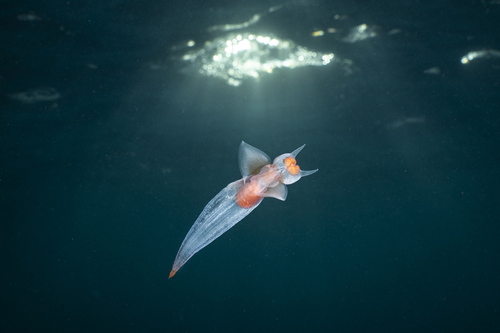
About Clione limacina (Phipps, 1774)
Clione limacina (Phipps, 1774) has two recognized subspecies that are distinguished by differences in adult body length. The northern subspecies, which lives in colder water, reaches sexual maturity at 3 cm (1.2 in) and can grow to a maximum length of 7–8.5 cm (2.8–3.3 in). This makes the northern subspecies of C. limacina by far the largest known sea angel. In comparison, the southern subspecies of C. limacina reaches only 1.2 cm (0.5 in) in length. Other species within the same genus grow to maximum sizes of up to 3 cm (1.2 in) for C. elegantissima, up to 0.8 cm (0.3 in) for C. okhotensis, and up to 3 cm (1.2 in) for C. antarctica.
C. limacina swims by beating its two wing-like appendages, allowing it to move upward or maintain a constant depth. Two statocyst gravity-sensing organs detect its orientation during swimming and correct its posture to keep it upright, with adjustments made using its tail.
C. limacina is distributed across the cold waters of the Arctic Ocean and North Atlantic Ocean, with its range extending south at least as far as the Sargasso Sea. Three additional species are currently recognized in the genus Clione; all three were formerly classified within C. limacina as subspecies, variants, or subpopulations. These are C. elegantissima, found in the cold North Pacific at least as far north as the Gulf of Alaska, while the Beaufort Sea is inhabited by C. limacina; C. okhotensis, native to the Okhotsk Sea, where its range overlaps with that of C. elegantissima; and C. antarctica, found in Antarctic waters.
C. limacina inhabits both the epipelagic and mesopelagic zones of the open water column. Studies of populations in Svalbard indicate that the species has a life cycle of at least two years. C. limacina is a simultaneous hermaphrodite, meaning individuals produce both male and female reproductive gametes at the same time. It breeds during spring and summer, and its eggs measure approximately 0.12 mm (0.0047 in) in diameter.
This species is preyed on by plankton-feeding animals, most notably baleen whales. This ecological role led historical sailors to give the species the common name "whale-food". Various species of fish also prey on C. limacina; the chum salmon, Oncorhynchus keta, is recorded as a major predator of these sea angels.

