About Cliona viridis (Schmidt, 1862)
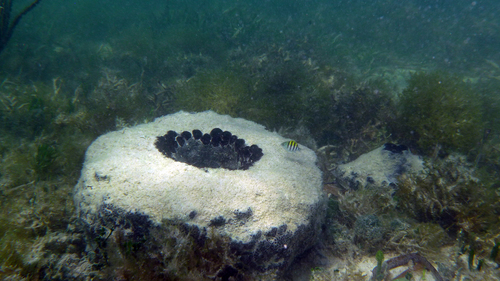
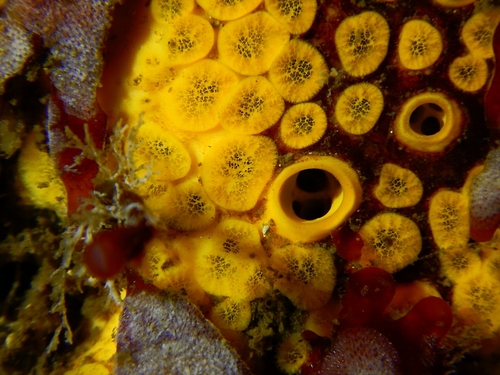
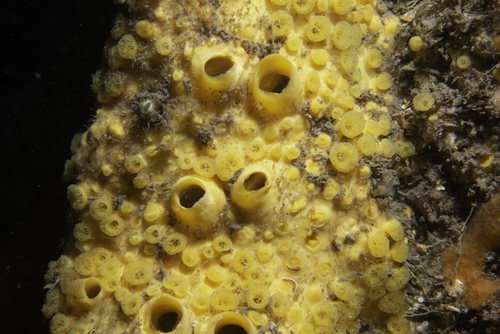
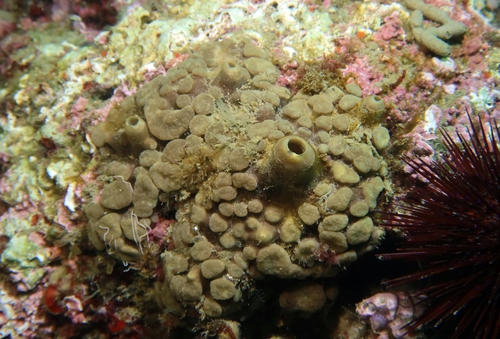
Cliona viridis is an excavating sponge. When growing on calcareous substrates, most of its body mass remains hidden beneath the substrate surface, with only its osculi (exhalent openings) and ostioles (inhalent pores) projecting outward. The osculi are a few millimeters wide, colored yellowish-green or light brown, and have pale rims. Ostioles are grouped together on flat-topped, sieve-like protuberances that can be white, yellow, or brownish-green. This species gets its color from zooxanthellae living in its tissues. In later growth stages, this sponge has a smooth, mosaic-like exterior surface made of firm, tough material. Under this surface, the sponge excavates galleries that reach up to 2.5 mm (0.1 in) in diameter. A full individual may form a globose structure around 15 cm (6 in) in diameter. Cliona viridis is distributed in the East Atlantic, Azores, Cape Verde Islands, Mediterranean Sea, and Indian Ocean. It has also been reported from the Caribbean Sea, though this report may stem from misidentification. It inhabits shallow water and can be found at depths down to approximately 367 meters (1,204 ft), occurring in both well-lit areas and semi-dark cave entrances. This is a common sponge, and it is the dominant sponge species in the shallow sublittoral zone in some parts of its range. It is found less often in deeper water, where it mostly grows on coralline algae.