About Cliona celata Grant, 1826
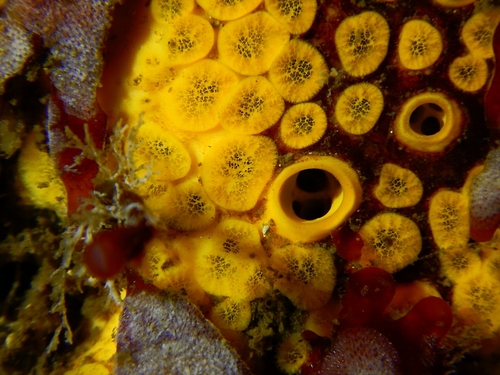
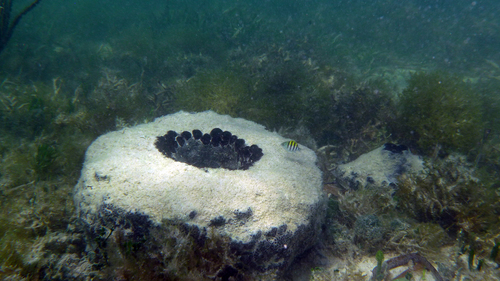
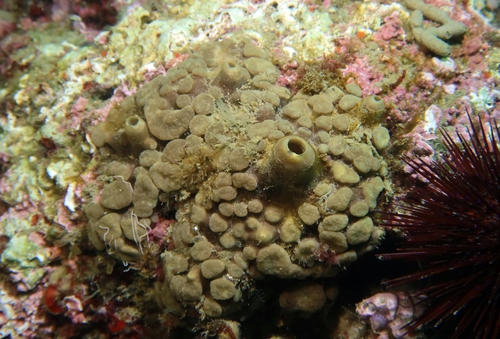
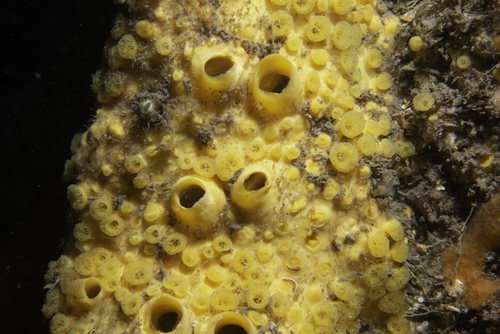
Cliona celata Grant, 1826 is a species of sponge. All sponges are asymmetrical, multicellular, diploblastic organisms that lack true tissues. They have two living cell layers: the outer pinacoderm and the inner choanocyte layer, separated by a non-living mesohyl layer. The pinacoderm is the epidermal layer made of contractile pinacocytes, whose contractions let the sponge change its shape. The choanocyte layer lines the sponge's inner space, and its choanocytes use flagella to create a water current that circulates water through the sponge. This current brings in food particles and sperm, both of which are collected by choanocytes. The non-living mesohyl holds living specialized cells called archaeocytes, which can modify themselves to meet the sponge's needs. Archaeocytes help with digestion, reproduction, waste elimination, and production of support elements. Spongin and spicules, the sponge's support elements, are also located within the mesohyl. This species has a leuconoid body plan, the most complex body structure a sponge can have. A leuconoid plan consists of many complex choanocyte chambers and a highly complex canal system, and it does not include a spongocoel. Water movement through Cliona celata follows this leuconoid structure: water enters the sponge through small pores called ostia, travels through incurrent channels, then passes through openings called prosopyles to reach flagellated canals. From there, water moves through additional openings called apopyles to excurrent channels, before being channeled into a larger passage that leads to the osculum, where water exits the sponge. Cliona celata inhabits coastal waters, where it bores into calcium-rich substrates. It can settle on both living and dead mollusks and other shelled creatures, and can also bore into limestone rocks and various types of coral. It is typically found in waters up to 200 meters deep. This sponge is distributed worldwide across the coastal waters of every continent except Antarctica, with high concentrations in the English Channel, the North Sea, and the Mediterranean Sea. In marine ecosystems, Cliona celata is an indicator species for pollution zones. Its primary ecological role is breaking down and dissolving calcium carbonate. When it bores into calcium carbonate substrates such as oyster reefs and coral reefs, it weakens the reefs and makes them more susceptible to harm. It often completely overgrows reefs, which reduces competition for other reef-dwelling organisms. Cliona celata can tolerate higher than normal water temperatures and salinity levels. Because of this high tolerance for environmental stress, reefs that have been damaged or destroyed by coral bleaching are especially vulnerable to being taken over by this sponge. Despite this negative impact, the calcareous material the sponge etches away contributes positively to the sediment composition surrounding reefs. When Cliona celata is eaten by predators, it can regenerate its lost papillae in approximately two weeks. Its predators include other benthic organisms: echinoderms, molluscs, polychaetes, and crustaceans. The sea urchin genus Arbacia is able to consume this sponge faster than it can regenerate. Cliona celata is a filter feeder: it draws water in through its ostia, and typically feeds on plankton and other organic matter suspended in the water column. Cliona celata can reproduce both asexually and sexually. Asexual reproduction occurs through either fragmentation or budding. In fragmentation, one or more segments of the sponge break off and grow into new individuals. In budding, a new bud forms on the parent sponge, matures, then breaks off to become a new independent individual. For sexual reproduction, the sponge produces gametes. Cliona celata is hermaphroditic, meaning a single individual produces both male and female gametes. Because sponges lack true tissues, they do not have a dedicated reproductive system to produce gametes. Instead, archaeocytes (the specialized cells found in the mesohyl) differentiate into sperm and egg cells. Egg production typically peaks in April and May. This species usually reproduces via broadcast spawning. Sperm is released into the water column through a sponge's oscula, then enters another sponge through its ostia. Choanocytes capture the incoming sperm, archaeocytes carry the sperm into the mesohyl, and the sperm is finally transported to eggs for fertilization. After fertilization, Cliona celata's embryo develops into a multi-flagellated parenchymula larva. This larva has a short free-swimming stage, before attaching to a substrate to continue its development into an adult sponge.