About Cliona californiana de Laubenfels, 1932
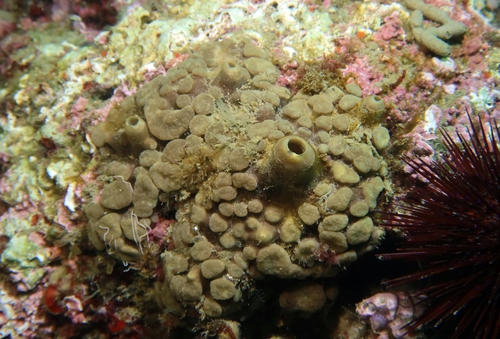
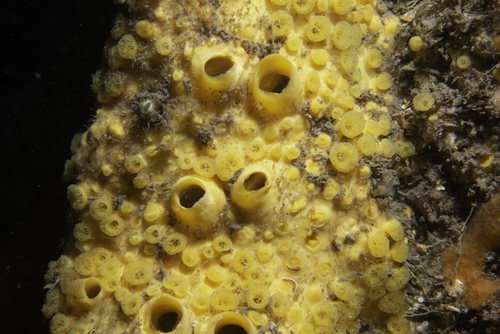
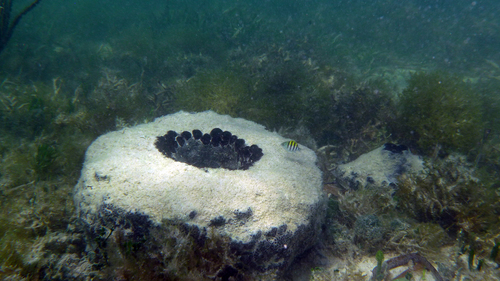
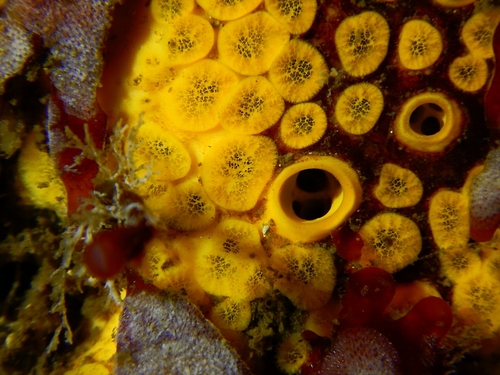
Cliona californiana, commonly called the yellow boring sponge, inhabits living bivalve molluscs by boring into their shell valves. Only small yellow patches, up to 3 mm (0.1 in) in diameter, are visible from the outside; these patches sometimes contain small oscula (openings). The sponge's silicaceous (glassy) spicules are scattered throughout its tissues, and are made entirely of megascleres called tylostyles. Tylostyles are single-shafted spicules that have a point on one end and a knob on the other. These distinctive spicules set this sponge apart from all other sponge species found in its local area. The yellow boring sponge is native to the northeastern Pacific Ocean, with a range that stretches from Alaska to Baja California. It is most commonly found in the subtidal zone, but also grows in the intertidal zone. It is more abundant in the colder waters of the northern portion of its range than in the southern portion, and can be found at depths down to approximately 120 m (400 ft). A newly settled young sponge travels to the shell of a suitable host and bores into one of the mollusc's valves, or into the plates of a host barnacle. The sponge's tunnelling weakens the host's shell, so scallop and oyster farmers consider this sponge a pest. When burrowing, the sponge secretes acid to dissolve the shell, then breaks off small shell pieces and moves them outside the shell. Once the sponge outgrows its tunnels, it spreads across the surface of the shell valve as a thick coating layer. When it becomes too large for its host, it develops into a free-living sponge that can reach up to 9 cm (3.5 in) in length and 6.5 cm (2.6 in) in height. This sponge is commonly found growing on the thick-shelled giant rock scallop (Crassadoma gigantea) and on oysters. The nudibranch Doriopsilla albopunctata preys on the yellow boring sponge.