About Clinus venustris Gilchrist & Thompson, 1908
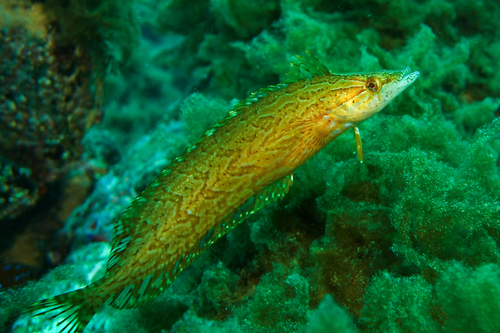
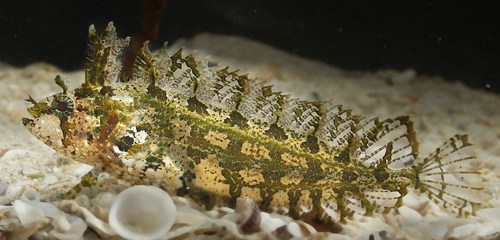
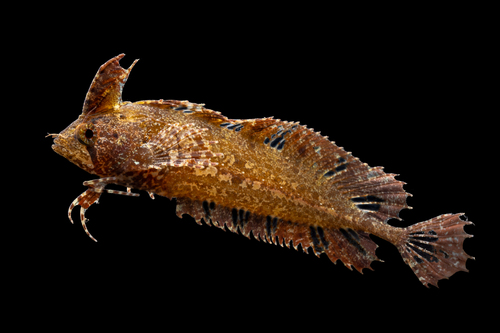
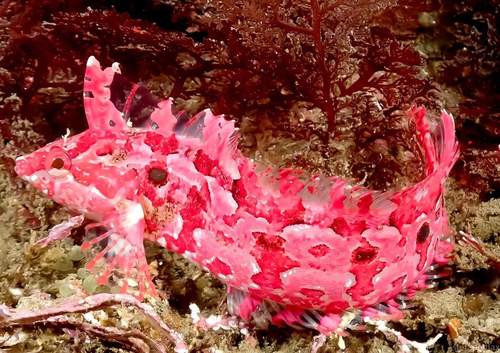
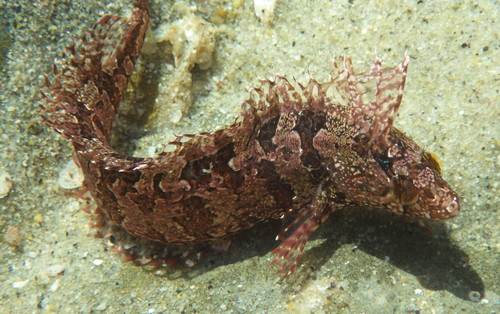
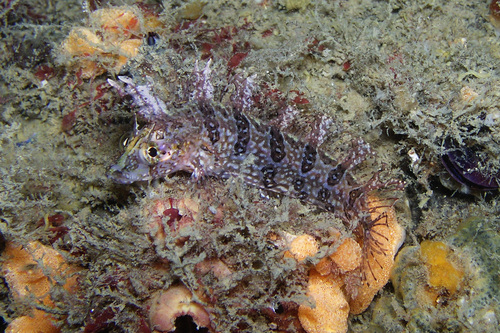
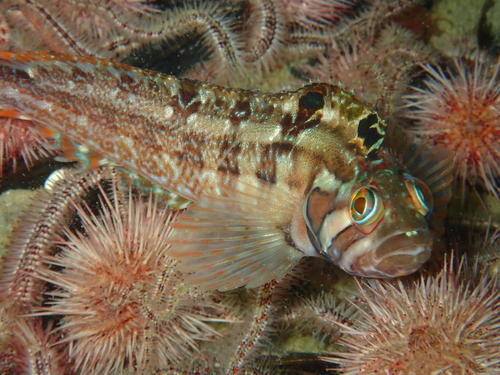
Clinus venustris, described by Gilchrist & Thompson in 1908, has a small, slender, moderately compressed body. Its head profile is slightly convex, with a forehead that slopes steeply toward large, prominent eyes, separated by a flat interocular space. The short snout ranges from slightly sharp to bluntly rounded, with an oblique mouth cleft and moderately thick lips. Each eye has a well-developed tentacle above and behind it: this tentacle forms a short, flattened fleshy stalk, fringed along the sides and tip with several short, simple branches. The cirri on the front nostrils are flattened, spoon-shaped, and have shallowly indented margins. The dorsal fin has a unique shape not seen in any other species: the first dorsal spine is short, approximately equal in height to the fourth dorsal spine, while the second and third dorsal spines are elevated, with the third less elevated than the second. There is no notch in the membrane between the third and fourth dorsal spines. Clusters of 2–3 cirri are present at the tips of the dorsal spines along roughly half the fin's length. The first two pelvic fin rays are elongated, and the third pelvic ray is absent. The caudal peduncle is short. This species has extremely variable colouration. Its base body colour is generally buff, overlaid with patterns in a wide range of colours including pink, olive green, light and dark brown, reddish, and yellowish. While some specimens are uniformly coloured, ranging from black, yellow, and crimson to nearly white, most have a pattern of vertical bars that are typically off-set along the lateral line, surrounded by small dots matching the colour of the bars. The overall appearance can be heavily mottled, with the pattern barely visible. Specimens collected from the coast north of Lambert's Bay are typically pale buff with brown streaks, speckles, and reticulations. Bright orange blotches may occur at the base of the dorsal fin, or irregular longitudinal brown bands may be crossed by broad, connected patches of the same brown shade. A bright blue, red-edged spot may be present over the first three dorsal spines. Fins may have red tips, and the anal fin is often entirely red. The branchiostegal membranes are pale with fine black dots, and have a characteristic dark line along the edge of the united gill membranes. Pectoral fins are mostly translucent, with rays matching the body's base colour. Key distinguishing features include: a yellow-edged, dark green or black spot on the first three dorsal spines, a second similar spot further back on the dorsal fin a short distance behind the pectoral fins, and sometimes a third similar spot even further back. The eyes have distinctive bright green and orange radial bands paired with a bright yellow iris. The face, particularly the cheeks, has two main colour patterns. The more common pattern features two bands matching the darker body bands: the first is narrow, sloping downward and backward from the eye, while the second is a deep comma shape that extends straight back from the eye before curving downward into a hook. A pale buff area lies between the two bands. The second, more variable pattern consists of spots of the darker body colour, sometimes forming a pattern similar to leopard spots. Some individuals show a combination of mottling and the two-band pattern. Juveniles match adults in both shape and colouration. The maximum recorded size for this species is 130 mm (5.1 in). Clinus venustris is an endemic species to Southern Africa, with a distribution ranging from Lüderitzbucht to Port Alfred. It inhabits subtidal reefs down to 30 m (98 ft) and pools at the bottom of the intertidal region, and it does not occur over sandy substrates. It is caught intertidally more frequently west of Cape Point than in areas east of False Bay. It can be common on reefs densely covered by hydroids and feather-stars, and is often spotted by divers. This species is viviparous.