About Clintonia umbellulata (Michx.) Morong
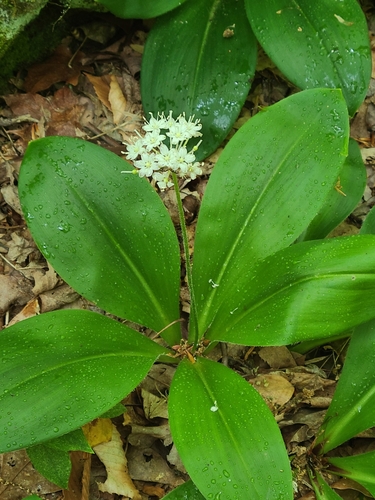
Clintonia umbellulata (Michx.) Morong is a perennial herbaceous plant that spreads via underground rhizomes. Mature plants reach 27 to 60 cm (11 to 24 inches) in height, and produce 2 to 4 dark green leaves. Each leaf measures 18 to 30 cm (7 to 12 inches) long and 4.5 to 8 cm (2 to 3 inches) wide. Its inflorescence is a single terminal umbel that holds 10 to 25, sometimes up to 30, outward-facing flowers, carried on a flowering stalk that can grow up to 50 cm (20 inches) high. Each flower has six tepals and six stamens. The tepals are white or greenish white, often marked with purplish brown or green speckles; individual tepals measure 5.5 to 8 mm (0.2 to 0.3 inches) long and 2.7 to 4 mm (0.1 to 0.2 inches) wide. The stamens are 60 percent longer than the tepals. The plant produces berries as fruit, which are black, and occasionally ultramarine blue. Each berry measures 6 to 8 mm (0.2 to 0.3 inches) long and contains 2 to 4 seeds. Each seed is approximately 3.5 mm (0.1 inches) long. This species is endemic to the Appalachian Mountains in the eastern United States, ranging from New York to Georgia. It has been recorded in the following counties: New York: Allegany, Cattaraugus, Chautauqua, Erie, Livingston, Wyoming; Ohio: Ashland, Ashtabula, Columbiana, Coshocton, Harrison, Holmes, Jefferson, Mahoning, Portage, Summit, Trumbull, Tuscarawas, Wayne; Pennsylvania: Allegheny, Armstrong, Beaver, Bedford, Blair, Butler, Cambria, Centre, Clarion, Clearfield, Crawford, Elk, Erie, Fayette, Forest, Franklin, Fulton, Greene, Huntingdon, Indiana, Jefferson, Lawrence, Mercer, Somerset, Venango, Warren, Washington, Westmoreland; Maryland: Allegany, Garrett; West Virginia: Barbour, Braxton, Fayette, Grant, Greenbrier, Hampshire, Hardy, Kanawha, Lincoln, Logan, Marion, McDowell, Mercer, Mineral, Mingo, Monongalia, Monroe, Morgan, Nicholas, Pocahontas, Preston, Randolph, Ritchie, Summers, Tucker, Upshur, Wayne, Webster, Wetzel, Wyoming; Virginia: Albemarle, Alleghany, Amherst, Augusta, Bath, Bedford, Bland, Botetourt, Buchanan, Carroll, Craig, Dickenson, Floyd, Franklin, Giles, Grayson, Greene, Henry, Highland, Lee, Madison, Montgomery, Nelson, Page, Patrick, Pulaski, Rappahannock, Roanoke, Rockbridge, Rockingham, Russell, Scott, Smyth, Tazewell, Warren, Washington, Wise, Wythe; Kentucky: Bell, Breathitt, Clay, Harlan, Jackson, Laurel, Lee, Letcher, Menifee, Morgan, Perry, Powell, Rockcastle, Rowan, Wolf; Tennessee: Blount, Campbell, Carter, Cocke, Cumberland, Greene, Hawkins, Johnson, Monroe, Morgan, Polk, Rhea, Sequatchie, Sevier, Sullivan, Unicoi; North Carolina: Alleghany, Ashe, Avery, Buncombe, Burke, Caldwell, Clay, Graham, Haywood, Henderson, Jackson, Macon, Madison, McDowell, Mitchell, Polk, Rutherford, Surry, Swain, Transylvania, Watauga, Wilkes, Yancey; South Carolina: Greenville, Oconee, Pickens; Georgia: Gilmer, Habersham, Lumpkin, Murray, Rabun, Towns, Union, White. Early sources report that the range of C. umbellulata apparently overlaps with that of C. borealis throughout the Appalachian Mountains, with counties where both species occur marked in bold. In reality, C. umbellulata and C. borealis are allopatric: their ranges do not overlap significantly, but are immediately adjacent to one another. C. umbellulata is globally secure, classified as rare and imperiled in New York, and endangered in Ohio.