About Clintonia udensis Trautv. & C.A.Mey.
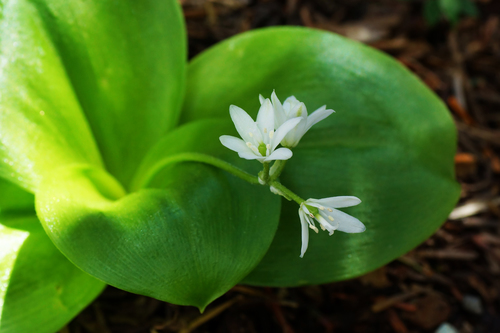
Clintonia udensis Trautv. & C.A.Mey. is a perennial herbaceous plant that spreads via underground rhizomes, forming colonies on temperate forest floors. It produces 3 to 5 egg-shaped to elliptical leaves, each measuring 8 to 25 cm (3 to 10 in) long and 3 to 16 cm (1 to 6 in) wide. Young leaf margins are covered in fine short hairs (pubescent). Its flowering stem, technically called a scape, is also pubescent, and measures 10 to 20 cm (4 to 8 in) long during flowering; the stem elongates to up to 60 cm (24 in) long when fruiting. The inflorescence holds 3 to 12 flowers arranged in short terminal racemes, with densely pubescent flower stalks (pedicels). The tepals are white, sometimes bluish, and each is 7 to 12 mm (0.3 to 0.5 in) long. The plant produces dark blue, almost black berries that grow up to 12 mm (0.5 in) across. Clintonia udensis has a wide distribution, ranging from the Russian Far East to southeast Asia, extending from the Kuril Islands in the Pacific Ocean west to the Western Himalaya region. The variety C. udensis var. alpina occurs in the Himalayas from Uttarakhand to Bhutan, Assam, northern Myanmar, and western China.