About Clintonia borealis (Aiton) Raf.
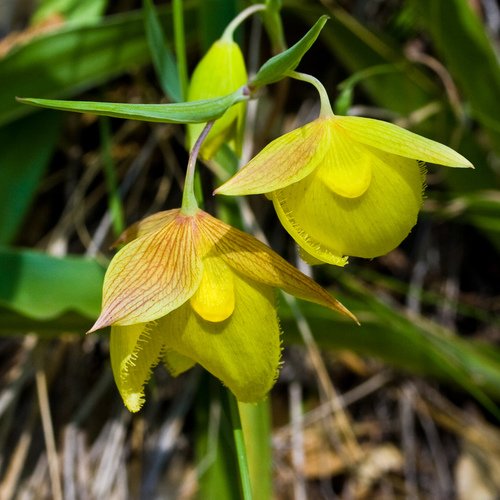
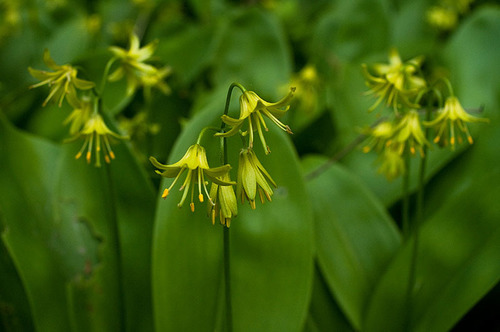
Clintonia borealis (Aiton) Raf. is a small perennial plant that reaches 5 to 10 inches tall, and usually grows in large homogeneous colonies. Fully grown shoots produce 2 to 4 clasping, curved, slightly succulent leaves with parallel venation. Its flowers are arranged in small umbels at the end of a long stalk, with 6 stamens and 6 yellow tepals—sepals and petals that look very similar. Rarely, a single shoot or clone may produce more than one umbel. The plant produces small, dark blue berries, which are semi-poisonous; a rare white-berried form, f. albicarpa, also exists.
This species reproduces both by seed and vegetatively via underground rhizomes, and spreads very slowly through either method. A single colony will often cover an area of several hundred square meters.
Clintonia borealis has a wide range across eastern North America, stretching from Newfoundland and Labrador, across New England and the Great Lakes region, west to Manitoba and Minnesota. Its range extends south into the Appalachian Mountains, where it is allopatric with C. umbellulata: the two species do not have significant overlapping ranges, but their ranges lie immediately adjacent to each other. In the Appalachians, C. umbellulata grows in hardwood forests below 1,000 m (3,281 ft), while C. borealis grows in coniferous or mixed forests up to 1,600 m (5,249 ft). This species is globally secure, but it is listed as threatened in Maryland and Tennessee, and endangered in Ohio and Indiana.
Clintonia borealis does not grow in open areas, and only thrives in shaded conditions. While it spreads extremely slowly, established clones can often survive many later habitat changes, as long as sunlight exposure remains limited. Crossed pollination produces seeds more efficiently, but self-pollination can also produce viable seeds to let the plant propagate. Like other slow-growing forest plants such as Trillium species, Clintonia borealis is extremely sensitive to grazing by white-tailed deer.
Cultivation of this species is difficult. It requires protection from direct sunlight, and its seeds germinate very poorly. Transplanting is not recommended.
The rhizome of this plant contains diosgenin, a saponin steroid with estrogenic effects. Its young leaves are edible when they are still only a few inches tall. Its fruit is mildly toxic and has a very unpleasant taste.