About Clinostomus elongatus (Kirtland, 1840)
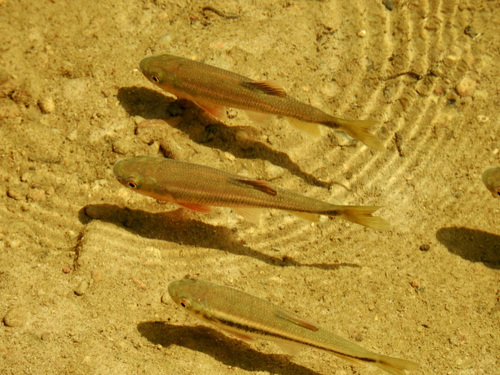
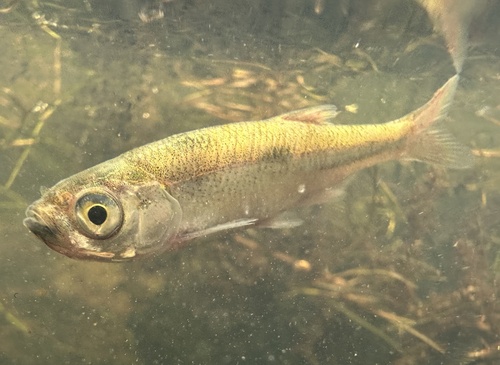
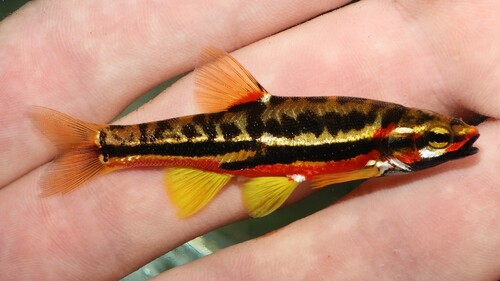
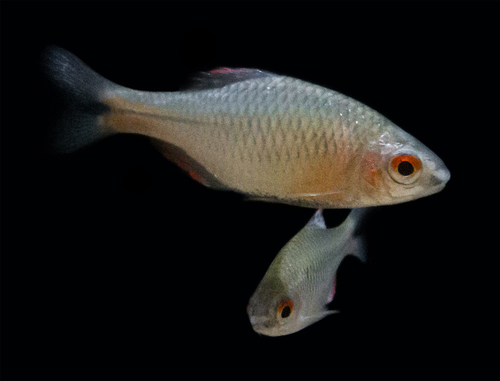
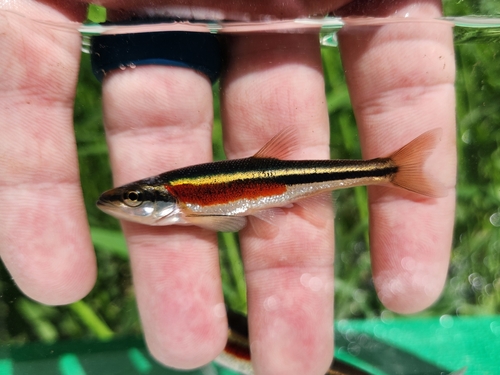
Clinostomus elongatus, commonly called the redside dace, is a brightly colored minnow species. It has a wide red stripe that runs along the middle of its body from the head to the dorsal fin, with a bright yellow stripe above this red lateral stripe extending from the head to the caudal fin. Its back is generally dark, ranging from green to dark blue in color. Unlike other minnows, this species has a very large terminal mouth and a protruding lower jaw, an adaptation that helps it capture prey from below. Adult redside dace average 65 mm (2.6 in) in total length, with a maximum total length of around 120 mm (4.7 in). Age estimates from scales indicate redside dace do not live longer than four years. By late summer of their first year of life, redside dace typically reach a length of 31–48 mm (1.2–1.9 in). This species looks similar to the rosyside dace (Clinostomus funduloides), but redside dace have longer, more slender bodies and brighter red coloration on their sides. The two species are also allopatric, meaning they do not share overlapping geographic ranges. Redside dace prefer slow-moving, cool, clear headwaters of river systems that have abundant overhanging riparian vegetation, particularly grasses, forbs, and low shrubs. Their preferred streams have a sequence of riffles, which are required for spawning, and pools that the fish occupy when it is not breeding season. Redside dace spawn opportunistically over gravel nests called chub mounds, which are built by creek chub (Semotilus atromaculatus), hornyhead chubs (Nocomis spp.), or stonerollers (Campostoma spp.). Spawning typically takes place in spring, and its exact timing depends on location, specifically latitude and climate, occurring when water temperatures reach or are near 18 °C (64 °F). During spawning season, males leave pool habitats and gather near spawning gravel. Before spawning, males perform territorial displays and courtship behaviors. Spawning involves multiple males gathering around a single female, and both males and female release gametes at the same time. The fertilized eggs are non-adhesive, stay in the nest, and receive no further parental care after being laid.