About Clinopodium menthifolium (Host) Merino
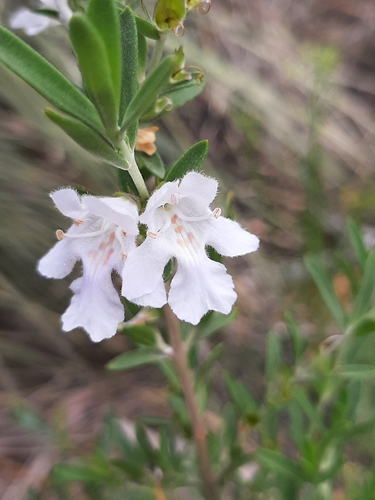
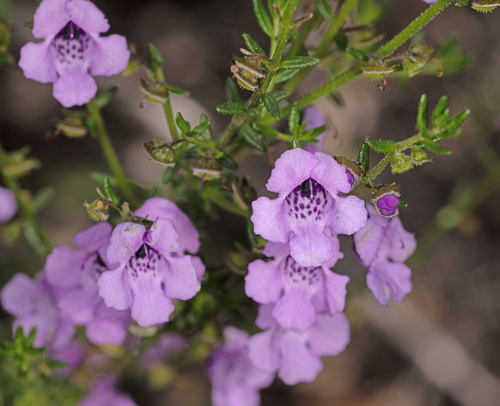
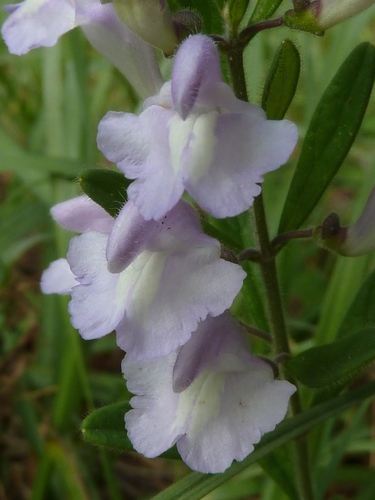
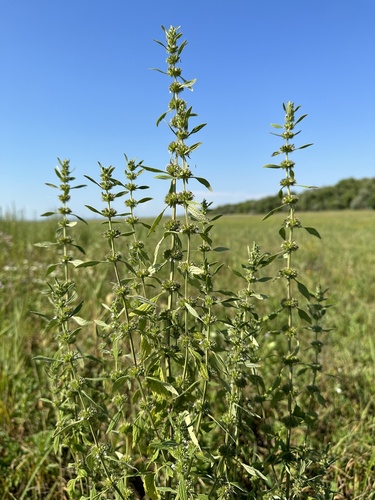
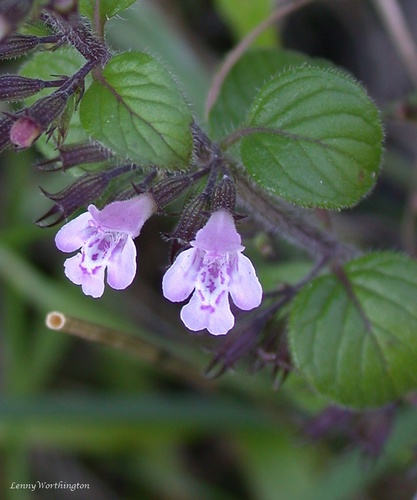
Clinopodium menthifolium subsp. menthifolium is a tufted, hairy, mint-scented perennial herb that grows in an upright form with few branches. It reaches a height of around 60 cm (2 ft). Its leaves are dark green, stalked, and grow in opposite pairs. Leaf blades are ovate with rounded teeth, and are larger than the leaves of Clinopodium menthifolium subsp. ascendens. Its lipped flowers are also larger and darker, with the corolla lobe at least twice as long as the hairy calyx. Clinopodium menthifolium subsp. ascendens grows to 30–60 cm (1.2–2.4 ft) in height. This perennial, rhizomatous, herbaceous hemicryptophyte has stalked leaves, an erect hairy stem, and tall flowering spikes. It produces pinkish or bluish flowers with spots on the white lower lip, which bloom from July to September. Wood calamint, the common name for Clinopodium menthifolium, is native to Western Europe and North Africa. Its range extends from France and Germany south to Spain and Algeria, and it is also found in Northern Syria. In Britain, it occurs only at a single site on the Isle of Wight, where it grows in ancient deciduous woodland on chalk soil. It has been introduced to the United States, where it is now naturalized in California and Virginia. Clinopodium menthifolium subsp. ascendens grows on dry, calcareous soils in hedges, roadsides, grasslands, and rocky areas. The leaves of wood calamint can be infused to make an aromatic herb tea. They can also be added to cooked foods, where they give a pungent, aromatic flavor described as a combination of marjoram and mint. This plant is also grown as an ornamental in gardens, where it attracts butterflies and bees. It has been used medicinally as a diaphoretic, an expectorant, and to settle the stomach. It is often added to cough medicine in combination with yarrow (Achillea millefolium) and thyme (Thymus vulgaris), and is also used to treat fever, insomnia, and depression.