About Clinocottus analis (Girard, 1858)
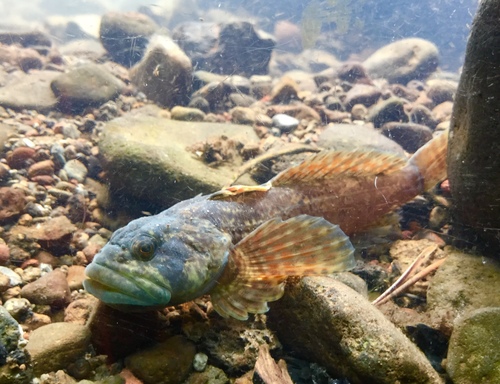
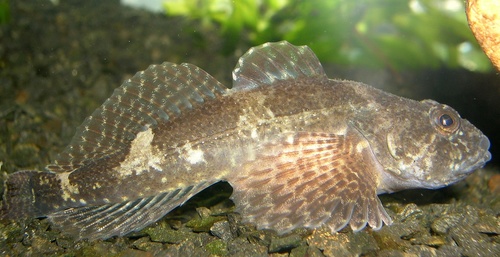
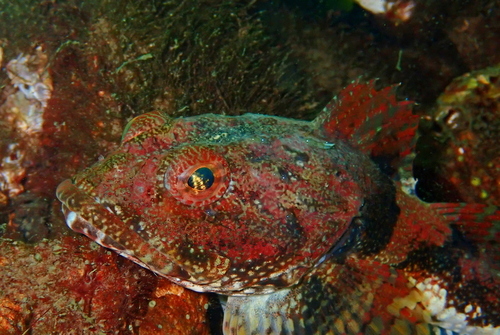
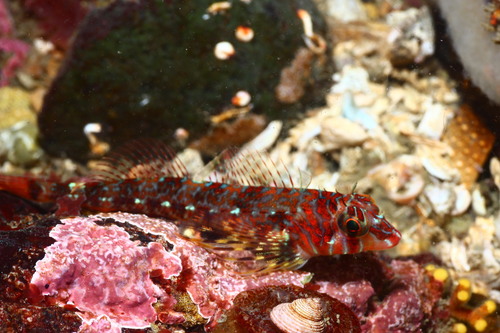
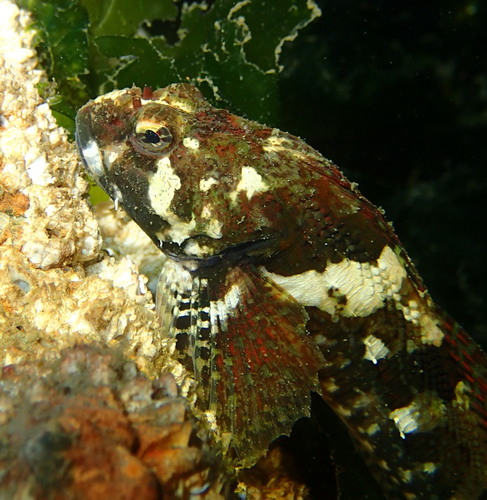
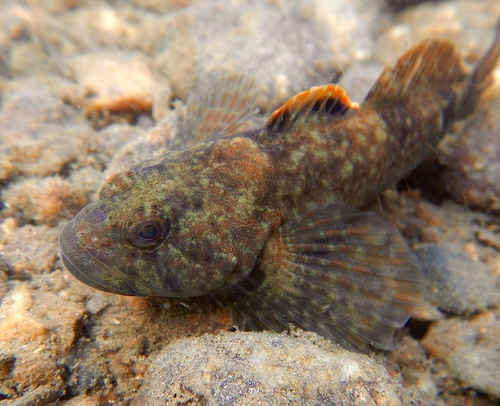
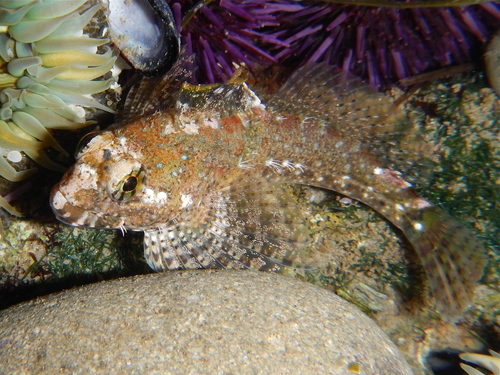
Clinocottus analis, first described by Girard in 1858, is a fish that reaches a maximum length of 18 centimeters. It has an elongated, speckled body that terminates in a large, wide, flattened head. Its eyes sit on the top of the head, positioned perpendicular to its large mouth, which is lined with many teeth. This species is scaleless; gills cover a large spine that ends in a pair of sharp spines. It has dorsal, anal, and caudal fins, each bearing between 12 and 15 rays. The caudal fin is rounded and darker in color than the rest of its body. This fish is most commonly found near sand, small rocks, and bedrock, particularly in intertidal areas up to around 19 meters deep. It inhabits waters with temperatures ranging from 6 °C to 22 °C, and can survive rapid fluctuations in both water temperature and salinity. Ecologically, this species lives on the seabed of intertidal waters up to 18 meters deep. It is commonly found in algae-filled tide pools, but can leave these areas on its own accord. It is capable of breathing air, and can survive out of water for up to 24 hours. This species is oviparous, with internal fertilization, and spawns in shallow coastal waters. Each female lays multiple batches of eggs per year, with each batch containing between 50 and 1,300 eggs. Eggs range in size from 12 to 25 mm, and larvae settle in tide pools after hatching. Within a few months, larvae mature to a total length of 50–60 mm.