About Clinocottus acuticeps (Gilbert, 1896)
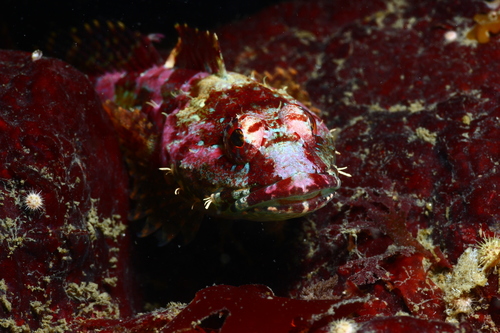
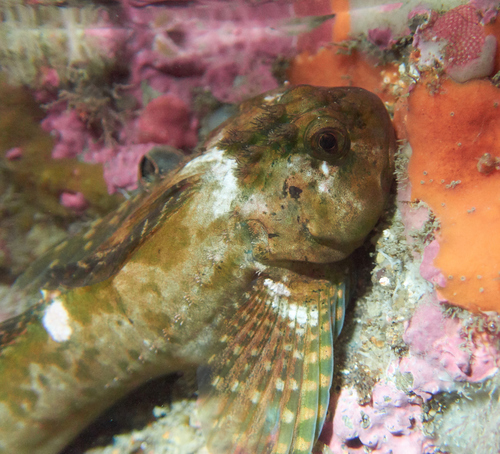
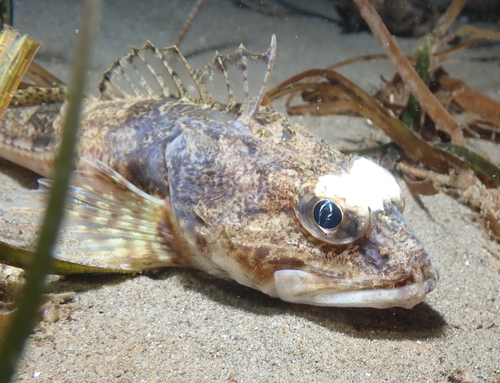
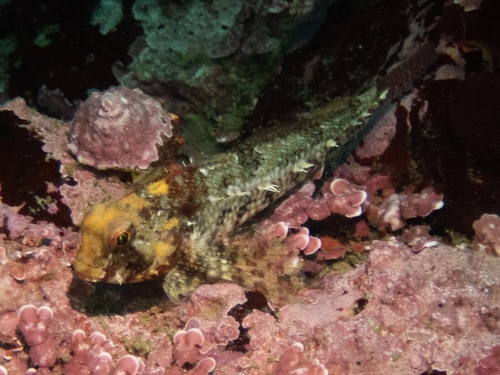
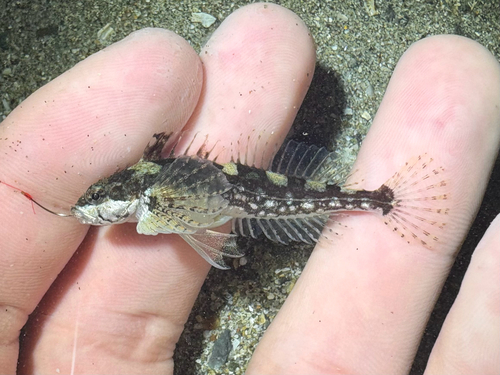
Clinocottus acuticeps is identified by a flattened, three-branched papilla near the anus, and cirri present on the eyeballs, head, lateral line, and at the tip of each dorsal fin spine. The lateral line sits high close to the head, curves downward along the middle of the flanks, and straightens as it approaches the caudal peduncle. Each of the first 15 lateral line pores has a slender cirrus. The penultimate ray of the anal fin is the longest. Pectoral fins extend to or just past the origin of the anal fin, and the caudal fin is rounded. Dorsal fins have between 7 and 9 spines and 14 to 16 soft rays, while the anal fin has 13 to 16 soft rays. This species reaches a maximum published total length of 6.4 cm (2.5 in). Their coloration varies based on habitat; individuals may be almost uniformly bright green, but the typical upper body color ranges from green to light brown, marked with dark wedge-shaped saddles that are widest at their lower edge. Individuals sometimes have a dark horizontal stripe along the lateral line that may be interrupted by pale spots. The underside is creamy to white. Three dark radiating lines extend from the eye: the first runs to the snout, the second down to the rear of the mouth, and the third backward to the base of the preopercular spine. There is a dark blotch on the spiny dorsal fin between the first and third spines. All fins except the plain pelvic fins are typically dusky with indistinct mottling or barring. Clinocottus acuticeps occurs in the Eastern Pacific Ocean along the North American Pacific coast, ranging from the Bering Sea to the Big Sur River in central California. It is common in rocky intertidal and subtidal areas, as well as on sand substrates, among eelgrass Zostera and macroalgae. If tidal pool water conditions become unsuitable, this species may leave the pool, and it sometimes enters fresh water. It prefers sand, gravel, and rock substrates that host mussels of the genus Mytilus.