About Climacteris affinis Blyth, 1864
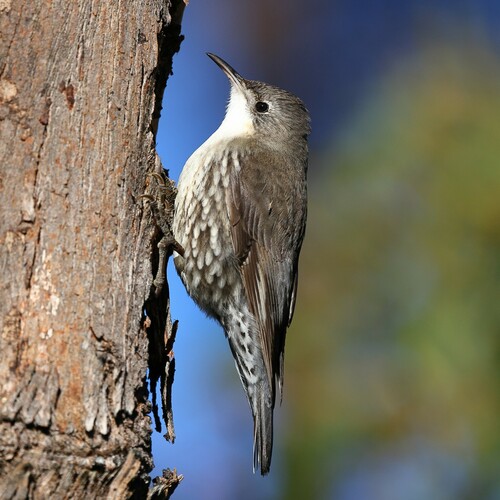
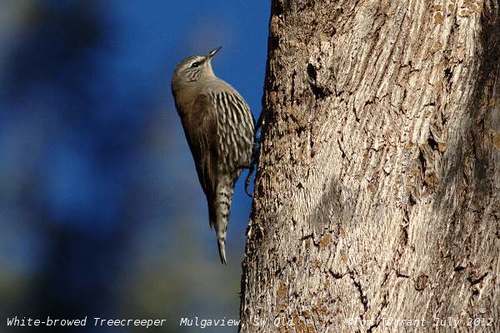
The white-browed treecreeper (Climacteris affinis Blyth, 1864) measures 14–16 cm in length, has a 22 cm wingspan, and weighs 21 grams. For adult males, most upper plumage (covering the crown, neck, rump, and uppertail) is dark grey; the mantle and scapulars are brown, and there is a black sub-terminal tail band. On the face, males have black lores, a tapered white eyebrow, and black-and-white streaked ear-coverts. The chin is white, the throat is brownish grey, the upper breast is grey, and the lower breast, belly, flanks, and vent are streaked black and white. Undertail coverts have black and white barring. Females are similar to males, but have a rufous stripe along the upper edge of the eyebrow, and dull white streaking tinged with rufous on the center of the upper breast. For both sexes, the bill is black, around 1.5–2 cm long, relatively straight and slender; the iris is dark brown, and the legs and feet are black. Juveniles differ from adults by having a pale grey bill, and both their facial patterning and ear-covert streaking are duller and less distinct. This species has moderately long wedge-shaped wings and a square tail. When flying over long distances, its flight is undulating: it uses brief bursts of flapping between long glides, and a buff wingbar is visible during flight. White-browed treecreepers live in arid and semi-arid regions across southern Australia, and do not occur in Tasmania. The ranges of the two recognized subspecies do not overlap: C. a. affinis is found east of Spencer Gulf, while C. a. superciliosus occurs west of Spencer Gulf. The species occupies a variety of woodland and shrubland communities dominated by Acacia, Casuarina, or Callitris species, and tolerates both dense and open understories. White-browed treecreepers are non-migratory (sedentary). Pairs or groups actively defend relatively large territories year-round, which average 8.4 hectares in some regions.