About Climacodon septentrionalis (Fr.) P.Karst.
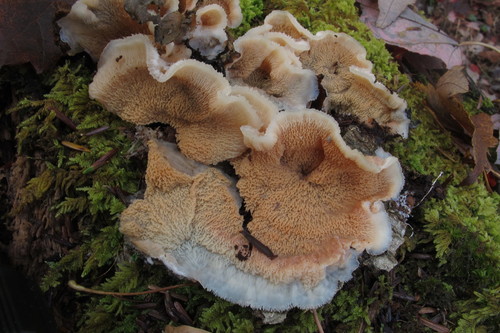
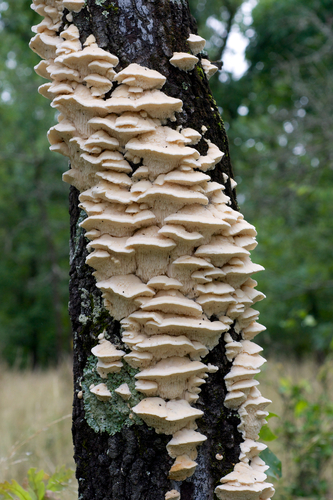
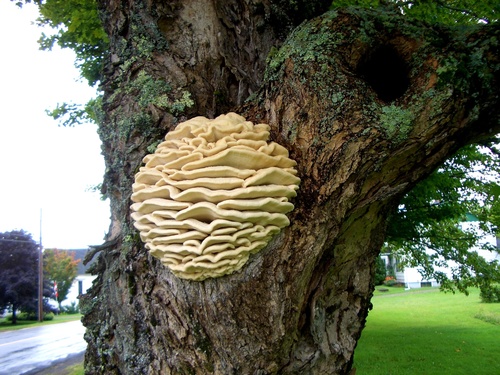
Individual fruiting caps of Climacodon septentrionalis are semicircular or kidney-shaped, growing up to 30 centimetres (12 in) across and 2.5–5 cm (1–2 in) thick at the base. Caps typically grow in large clustered groups that can reach 80 cm (31+1⁄2 in) in total height. Young caps are mostly white to yellow-cream, and gradually turn yellow-brown as they mature. Because caps persist for multiple weeks, algae often grow on their surface, giving them a faintly green appearance. The cap surface is rough, sometimes hairy, and marked with concentric rings that radiate out from the base. The underside of the cap bears numerous white spines up to 1 cm long, which also turn yellow as the cap ages. This fungus is a common cause of heart rot in hardwood trees within its native range. It grows on the trunks of living and recently dead hardwood trees, most commonly beech (Fagus) and maple (Acer) species. It is native to northeastern North America, where it can be found from August through October; its range extends from southern Canada south to Kentucky, and west as far as the Great Plains. Climacodon septentrionalis is edible, but not considered palatable because of its tough flesh and bitter taste.