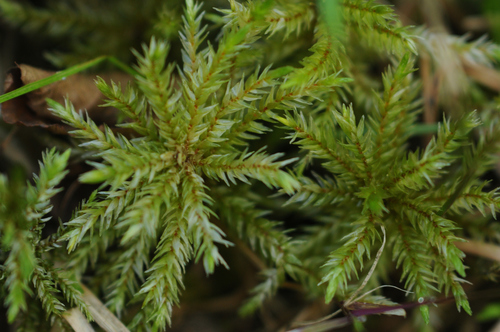
About Climacium dendroides (Hedw.) F.Weber & D.Mohr
Climacium dendroides (Hedw.) F.Weber & D.Mohr ranges in color from dark green to yellow, and may be glossy when dry. It has distinct stem leaves and branch leaves with different structures. Stem leaves are broader than branch leaves, have an obtuse apex, lie flatter against the stem, lack pleats, and contain multiple laminal cells near their insertion. Stem leaf insertions are well-spaced, all with round tips. Branch leaves are narrower than stem leaves, have toothed margins near the tip and longitudinal folds. Both stem and branch leaves are egg-shaped, though branch leaves are narrower. Stem leaves have multiple laminal cells near insertion, while branch leaves have elongated leaf cells. Both leaf types have enlarged, thin-walled hyaline cells around the basal angles. All leaves are approximately 2.5–3 mm long. Leaf arrangement gives the plant a palm tree-like growth form. Upright stems 2–3 cm tall grow from prostrate rhizome-like primary stems; in areas with abundant moisture, these upright stems form clear tree-like structures up to 2–10 cm tall, while they remain shorter in dry locations. Stems are reddish-brown, and upright stems hold small green filaments, with the tree-like structures developing from branched horizontal stems. The base of branch leaves where they attach to the stem is flat, continuous with the leaf outline, and ranges from round to cordate and auriculate due to margin flexion. This species is dioecious, with male plants being much rarer than female plants. Its upright, oblong-cylindric capsules measure 1.5–4 mm long, and are rarely encountered. Capsules are short-cylindric and typically mature in fall; sporophytes are most often found in late winter and early spring in moist areas. Sporophytes have a long seta with a terminal sporangium, an operculum cap on the capsule, a calyptra that covers the capsule, and peristome teeth that control spore release. Spores are unicellular, released when the operculum splits open, a process that can be aided by hygroscopic dehiscence. This species most commonly dominates moist and damp habitats including swamps, peatland, lake edges, humus-rich woods, and areas with periodic water level fluctuation. It grows terrestrially, or as a dominant species on wood and logs, and rarely grows on rocks or in dry areas. It occurs from sea level to subalpine elevations, and also grows in alpine tundra. The species is relatively widespread but not common, with a distribution that includes northern to central Europe, Asia (including Japan and Korea), the South Island of New Zealand, and North America. In North America, it occurs in the Northeast above 45°N, and extends as far south as western New Mexico. Like other bryophytes, Climacium dendroides has a life cycle centered on a haploid gametophyte generation, rather than the diploid dominant generation seen in vascular plants. The life cycle begins when a haploid spore germinates to form a protonema, which is made up of thread-like filaments or a thallus, and consists of three structures: chloronema, caulonema, and rhizoids. Chloronema develops first: it is irregularly branched, has non-pigmented transverse crosswalls, contains round chloroplasts, and does not produce buds. Next, caulonema forms: it is regularly branched, has pigmented oblique crosswalls, contains spindle-shaped chloroplasts, and produces buds. Rhizoids anchor the later-developing gametophyte to the substrate. The protonema then produces gametophores, which are structurally differentiated into stems and leaves; a single protonema can produce one or more gametophores. Gametophytes develop from caulonema buds, and mitosis produces the haploid sex gametes (sperm and eggs). Since this species is dioecious, each gametophore produces only one type of specialized sexual structure, holding either sperm or eggs. The female sexual structure is the archegonia, which is surrounded by a cluster of modified leaves called the perichaetium. Archegonia are small flask-shaped structures with a neck-like venter; sperm swim down the venter to reach the enclosed egg, and fertilization occurs inside the archegonium. Male sexual structures are called antheridia, and are protected by modified leaves called the perigonium. Fertilization requires water: biflagellate sperm are transported from antheridia to archegonia, swim down the venter to the egg, and fertilization produces a diploid sporophyte. The immature sporophyte then grows out from the archegonial venter. A mature sporophyte is made up of a seta that supports the sporangium, a capsule topped with an operculum, and a calyptra (a covering that grows from the archegonial venter and is the only haploid structure in the sporophyte). When the sporophyte is fully mature, the calyptra falls off to expose the peristome teeth inside the capsule. Meiosis occurs inside the sporangium to produce haploid spores, which are released through the action of the peristome teeth. Spores are typically carried by wind to a new substrate, where the life cycle repeats.

