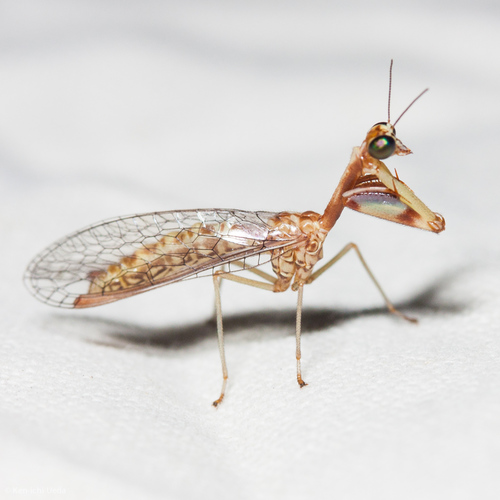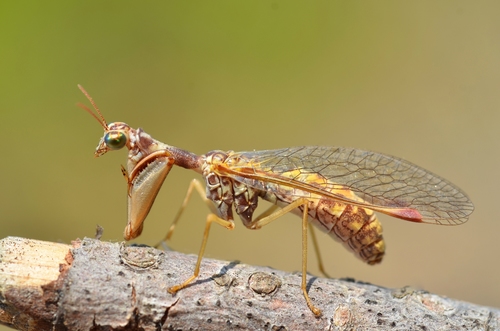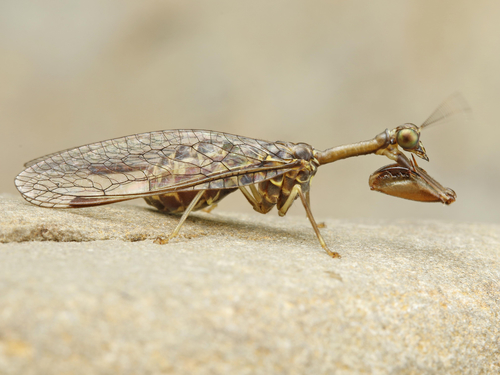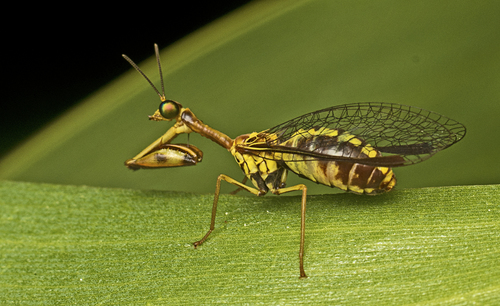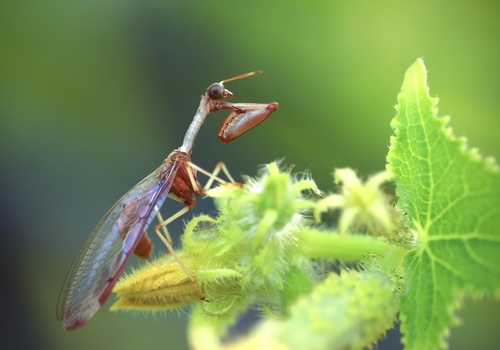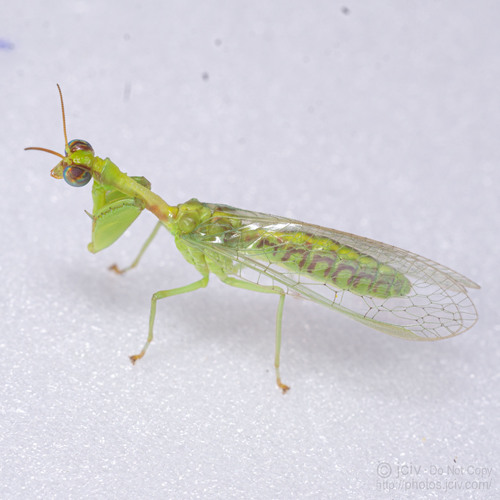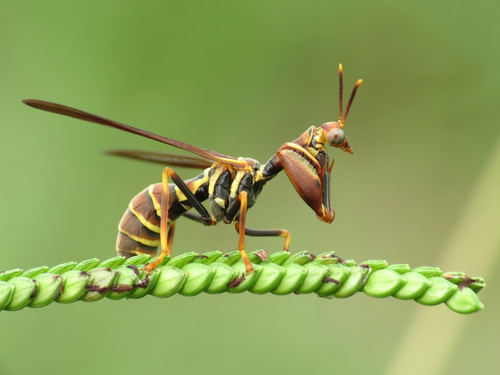
About Climaciella brunnea (Say, 1824)
Climaciella brunnea has a triangular head with large compound eyes and a broad frons, and straight antennae. Its raptorial forelegs are similar in both shape and function to those of mantises (order Mantodea); this trait evolved independently in the two groups and is an example of convergent evolution. The species' wings are distinctive: they often have thick brown edges and transparent inner areas. Adult body length ranges from 2 to 3 cm. Its body markings mimic those of wasps in the genus Polistes. C. brunnea shows extensive color polymorphism, as different populations mimic the coloration of the specific Polistes wasps found in their local region. Climaciella brunnea is distributed across Canada, the United States, and extends south as far as Nicaragua. It is difficult to find single individuals, and the species is most commonly encountered in aggregations. Groups of C. brunnea gather in areas to breed and feed, attracted by a male pheromone. Adults can be found resting on vegetation or flowers in forest clearings. Individuals often sit on flower heads to wait for prey or feed on nectar, so the species has some impact on pollination and is recognized as a casual pollinator. First instar larvae of this species are campodeiform, and use phoretic behavior to seek out an adult spider. C. brunnea specifically targets lycosid (wolf) spiders. Larvae have a unique adaptation called a caudal sucker, which they use to attach themselves to the substrate of their habitat. After attaching, they lift their body and wave it back and forth for a short period. If they do not catch onto a passing spider in this time, they rest briefly before starting their phoretic behavior again. Once a larva reaches an adult spider, it stays on top of the spider's carapace until the spider either copulates or begins laying eggs. If the larva attached to a male spider, it will quickly transfer to a female spider when the male mates. If the larva was on a female spider from the start, it will stay on her until she lays eggs. Until this point, the larva feeds on the spider's hemolymph to survive. When the spider is ready to lay eggs, the C. brunnea larva moves quickly into the sticky fluid the spider uses to build its egg sac, and becomes trapped inside the sac. Inside the sac, the larva uses a specialized sucking tube formed from its maxilla and mandibles to feed on the spider's eggs. Male C. brunnea attract females using a distinctive pheromone. Once a female is located, males perform an elaborate courtship ritual. They repeatedly spread and raise their wings, while also extending and stretching their raptorial forelegs. Males repeat this sequence for a few minutes, then stop and will resume the behavior if the female does not respond. If the female is receptive, the two individuals mate. Mating pairs can remain copulating for up to one day. After mating is complete, the male leaves a spermatophore on the female's genitalia. Over the following few days, the female absorbs this spermatophore and begins fertilizing her eggs. After fertilization, the female C. brunnea lays her eggs sporadically in crescent-shaped groups.