About Clibanarius vittatus (Bosc, 1802)
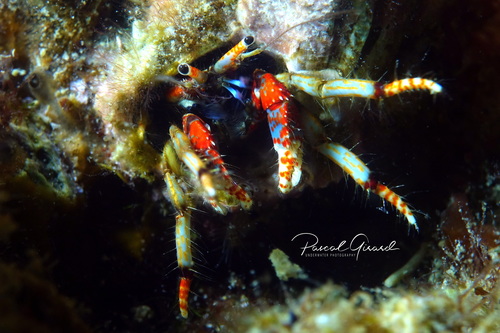
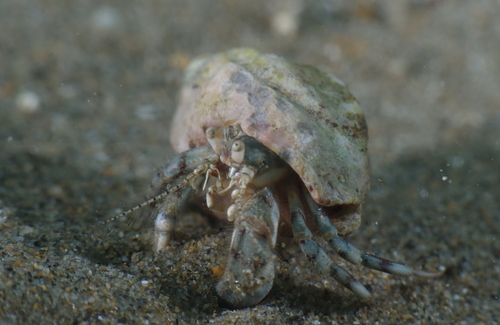
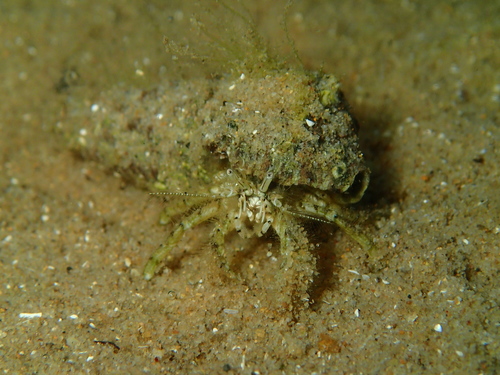
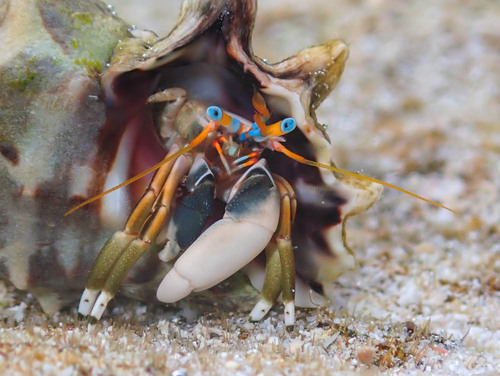
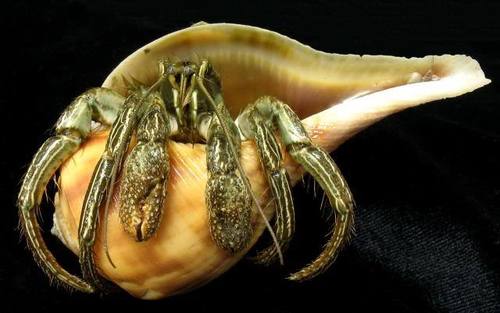
Like other hermit crabs, Clibanarius vittatus lives inside the empty shell of a gastropod mollusc. This shell protects its soft abdomen, and normally only its head and limbs project out through the shell's aperture. The claw-bearing legs (chelipeds) and claws of Clibanarius vittatus are small, both the same size, and covered in short bristles. When the crab feels threatened, it retreats back into the shell, and the chelipeds block the shell aperture. Small blue tubercles are present on the outer surface of the claws. The body and legs are dark green or brown; the body has faint white streaks, and the legs have more distinct white or grey stripes. Adult individuals often occupy gastropod shells that are over 10 cm (4 in) long. Clibanarius vittatus occurs in shallow waters of the Caribbean Sea, the Gulf of Mexico, and the western Atlantic Ocean. Its geographic range extends from Virginia on the eastern coast of the United States southward to Brazil, and it is plentiful in Florida's Indian River Lagoon. It is more resistant to desiccation than many other hermit crabs, and lives in the intertidal zone as well as at depths down to around 22 metres (72 ft). It can be found on sand or mud substrates, in seagrass meadows, on rock jetties, in oyster beds, and other inshore habitats. As Clibanarius vittatus grows, it periodically needs to exchange its current shell for a larger one. It is most vulnerable to predators during this shell-switching period. If a suitable vacant shell cannot be located, crabs may fight one another for available shells, or even kill living molluscs to claim their shells. The shells Clibanarius vittatus chooses are usually from whelks or conches, including selected species such as the lightning whelk (Sinistrofulgur sp.), knobbed whelk (Busycon carica), giant triton (Monoplex parthenopeus), moon snail (Neverita duplicata) and Florida rocksnail (Stramonita haemastoma). The sea anemone Calliactis tricolor is often found attached to shells occupied by Clibanarius vittatus, in what appears to be a mutualistic relationship. The crab benefits because the anemone's stinging cells deter potential predators, while the anemone gains greater access to food as the crab moves around.