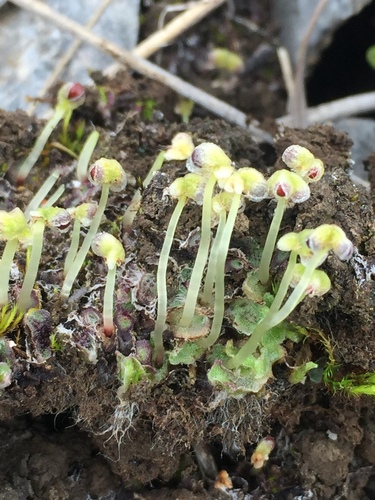
About Clevea hyalina (Sommerf.) Lindb.
REMARKS: Clevea hyalina grows in Jbel Serj National Park. It is found on the north - side of a calcareous cliff covered with rupicolous and grazing - resistant plants, in a sub - horizontal soil pocket. This strongly calcicolous species occurs in two distinct latitudinal belts with very different habitats. In the Arctic, it grows on polygons and solifluction slopes alongside cold - adapted species like Arnellia fennica and Sauteria alpina. In warmer, low - elevation regions, it is usually restricted to steep, shaded, densely - forested slopes and cliff bases, similar to its habitat in Tunisia. Associated species include xerothermophytes such as Encalypta vulgaris and Targionia hypophylla. There are two major types of strongly disjointed distributional ranges. 'Arcticalpine taxa' occur in boreo - arctic regions and at high elevations in southernmost mountain ranges, likely due to post - glacial warming causing northward and upward migrations. Taxa at different ploidy levels can also have disjointed ranges related to different ecological needs. The proportion of polyploids in mosses increases with latitude in North America and Europe, likely due to their better ability to colonize deglaciated northern areas after the last glaciation. The disjointed distribution of Clevea hyalina may follow one or both of these patterns and is a heritage of its ancient glacial distribution. The species has long ventral hyaline scales projecting beyond the thallus apex margins and blackish ventral scales. The cells around the pores are stellate with thickened radial walls. The Tunisian specimen was sterile. Jovet - Ast & Bischler (1971) studied Tunisia's liverwort flora but did not record Clevea hyalina. One possibility is that it's hard to spot in the dry season or is genuinely rare and localized, as shown by few North African reports. The species reaches its southern limit in the Maghreb and is also present in Algeria and Morocco. Clevea hyalina is a circumpolar arctic - montane species found in Europe, North Africa, Central and North Asia, and North America.

