About Clerodendrum bungei Steud.
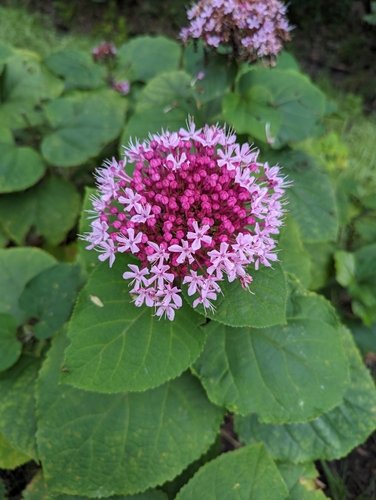
Clerodendrum bungei is a deciduous shrub that grows up to 2 meters tall. Its leaves are heart-shaped (cordate), 10–20 cm long, slightly narrower than they are long, and have coarsely toothed edges. Flowers bloom in late summer, in shades of rose, crimson, or pink. They are arranged in a noticeable, rounded terminal inflorescence called a corymb, which can reach up to 10 cm in diameter. Like other species in the Clerodendrum genus, this species has a five-lobed calyx. At the center of each flower sits a slender tube approximately 3–4 cm long, which ends in five spreading white lobes. The flowers carry a pleasant fragrance, but crushed leaves release an unpleasant odor. Clerodendrum bungei has extrafloral nectaries that produce a sweet secretion, which attracts ants and other arthropods. These visiting arthropods often protect the plant from herbivory in return. Clerodendrum bungei is native to Taiwan, Vietnam, and all mainland provinces and autonomous regions of China except Jilin and Liaoning. It grows along roadsides and in mixed forests on mountain slopes below 2500 m in elevation. Clerodendrum bungei was first introduced to Europe around 1850 by Scottish plant collector Robert Fortune. At Kew Gardens in England, it was grown as a greenhouse plant until another nursery confirmed that it can survive winter cold. Cultivated plants reach the same maximum height of 2 m as wild plants. In the British Isles, frost frequently kills the above-ground portions of the plant, but it grows new vigorous, erect, woody shoots the following summer. In colder regions such as the U.S. state of Missouri, it is grown in containers and overwintered indoors in sunny rooms or conservatories. Its flowers attract butterflies. This species is known for its suckering growth habit and rapid growth, which let it form large spreading colonies. While it is valued for its attractive flowers, its aggressive spreading growth means it is best suited for somewhat isolated areas. C. bungei has escaped from cultivation in North America, and has naturalized across a range from Texas to Georgia and Florida.