About Clemmys guttata (Schneider, 1792)
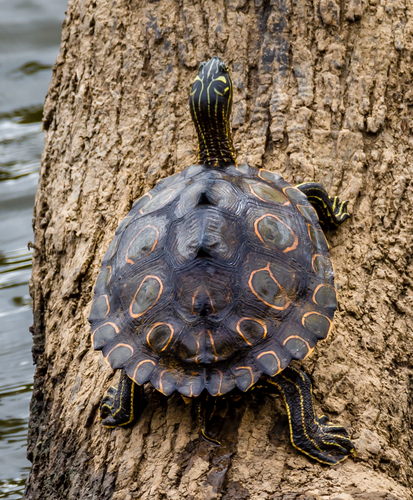
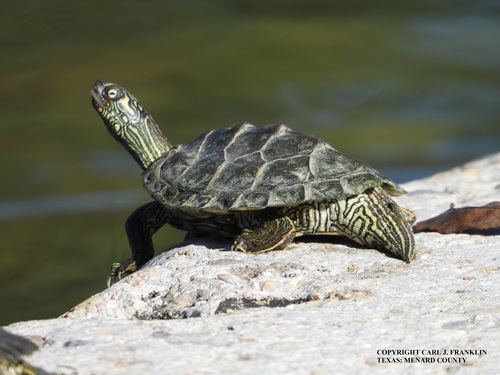
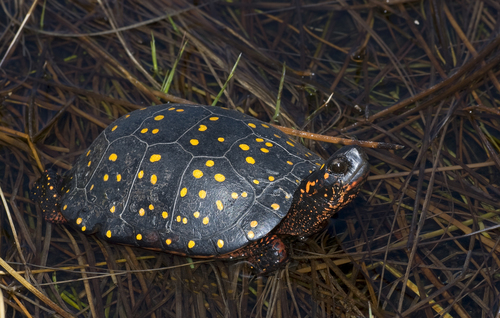
Clemmys guttata, commonly called the spotted turtle, is a small turtle with a gray to black base body color. Its smooth upper shell (carapace) lacks a central keel, and reaches 3.5–12.5 cm (1.4–4.9 in) in length. The carapace is mostly black, and can hold between zero and roughly 100 yellow spots, which are the species' defining characteristic; studies have found the left side of the carapace typically has more spots than the right. Spots are always present on the turtle's head, neck, and limbs.
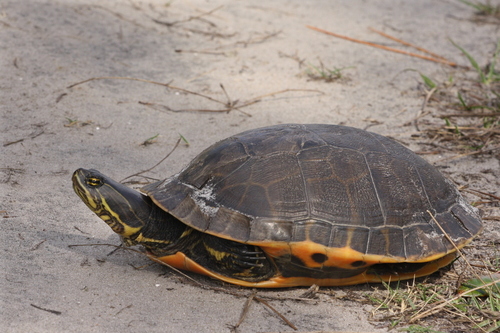
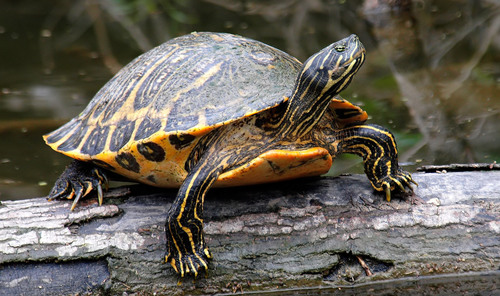
The lower shell (plastron) is yellow or orange-yellow, with one black spot on each of its scute sections. As the turtle ages, melanism spreads across the plastron until the entire surface turns black. The turtle's head is black, with a notched upper jaw, one large orange blotch on each side of the head, and several yellow bands of varying sizes. The turtle's dorsal skin is black with sparse yellow spots, while its ventral skin may be brighter, colored orange, pink, or red. These lightly pigmented areas vary geographically, and some individuals have yellow striping on the tail. Southern populations of spotted turtles tend to have smaller, less conspicuous spots than populations further north. The spotted turtle has a karyotype of 50 chromosomes.
Visible sexual differences develop around sexual maturity. Males have a tan chin, brown eyes, a long thick tail, and a concave plastron. Females have a yellow chin, orange eyes, a shorter tail, and a flat or convex plastron. On average, females are slightly larger than males, and have more spots on average. Hatchlings closely resemble adults, and consistently have exactly one yellow spot per carapace scute.
The spotted turtle's distribution extends from southern Maine, Quebec, and Ontario south along the eastern United States to eastern Florida, and west to central Indiana and Ohio. Disjunct populations exist in the Canadian part of the range, as well as in central Illinois, central Georgia, North Carolina, South Carolina, and Indiana. In Indiana and Illinois, the species is only found in the northern portion of the state, while it occurs across most of Michigan's lower peninsula. In Ohio, the species' highly fragmented range only covers the northern two-thirds of the state.
Spotted turtles live in a wide variety of habitats, including swamps, bogs, fens, marshes, woodland streams, wet pastures, tide-influenced brackish streams, ditches, vernal pools, and sedge meadows. A viable habitat must have soft substrate and at least some aquatic vegetation. An optimum habitat includes shallow slow-moving water with soft muddy soil, plus sedge tussocks, water lilies, sphagnum moss, and cattails. Because spotted turtles are very often found in areas with duckweed, their yellow spots may function as camouflage. They avoid artificial reservoirs and deep open-water areas.
The spotted turtle is noticeably terrestrial, spending a large amount of time on land, and will sometimes bask on grass patches near its water body. Females travel onto land to nest, laying eggs in sunny soil; nesting may also occur in other terrestrial sites, such as near man-made dikes or muskrat nests.
A study of spotted turtle reproductive biology in Pennsylvania found that the species does not reach sexual maturity until 8 years of age. After reaching maturity, courtship and nesting typically occur between March and June. During courtship, one or more males frantically chase a female for roughly 15 to 30 minutes, often biting the female's tail and legs during the chase. If two males are chasing the same female, they will occasionally stop the chase to fight, after which the losing male retreats. When a male catches a female, he mounts her, places his tail beneath hers, and grasps her carapace tightly.
Females build nests in well-drained areas exposed to full sunlight. Clutch sizes range from 1 to 8 eggs, with an average of 3 to 4. Spotted turtles exhibit temperature-dependent sex determination: the ambient temperature during incubation determines the hatchling's sex, with lower temperatures producing males and higher temperatures producing females. After laying eggs, females arrange eggs in the nest with alternating hind foot movements, then use their hind feet to scrape soil and grass back into the nest cavity. Incubation periods are estimated to range between 70 and 83 days.
Like other turtles with temperature-dependent sex determination, some researchers suggest global warming could have a harmful impact on spotted turtle population sex ratios. Spotted turtles become inactive during the freezing temperatures of winter and extreme heat of summer, but the species is relatively tolerant of drought. They become active very early in spring, and are often active in relatively cold water temperatures during this season. Activity peaks between April and May in the northern part of their range. When summer water temperatures exceed 30 °C, they may enter long periods of aestivation on land or in water. During summer dormancy, turtles may burrow into leaf litter in woodlands, marsh edges, or open fields; others stay in muskrat burrows or other aquatic refuges. Litzgus and Brooks (2000) have questioned the common assumption that summer dormancy evolved to avoid high temperatures; data from Ontario and other locations suggests avoiding predation and conserving energy are plausible alternative explanations. Regardless of the reason for dormancy, the winter dormant period usually begins in late summer or fall, almost always after the turtles return to aquatic habitats.
Spotted turtles have small home ranges, averaging around 0.5 to 3.5 hectares (1.2 to 8.6 acres). Due to their small size, spotted turtles are highly vulnerable to predation, especially during their frequent travels over land. Most individuals have visible mutilation injuries or scars from past predation attempts. Raccoons (Procyon lotor) are particularly effective at killing and eating spotted turtles. When surprised while basking, spotted turtles dive into the water and bury themselves in bottom mud. Muskrats kill many spotted turtles during the winter dormant period.