About Clematis terniflora DC.
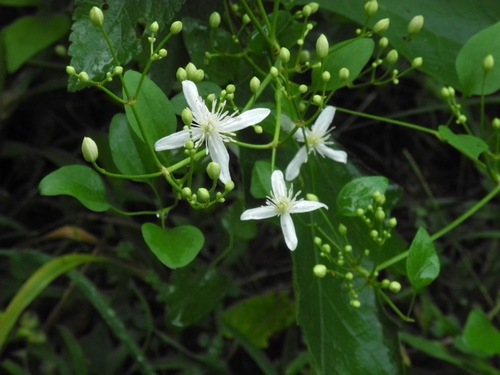
Clematis terniflora DC. is a woody vine with opposite, pinnately compound leaves. The leaves have a leathery texture, a shiny green color, and hold 3 to 5 oval to elliptic leaflets with cordate bases. Its climbing branches are shallowly 4 to 10-grooved. Mature plants reach 15 to 30 feet tall and 15 to 30 feet wide. The plant produces white flowers that bloom in fall. Flowers are bisexual, though some individual flowers in the same inflorescence may be unisexual. Each flower has a slender 1 to 3.5 cm long pedicel, and its white sepals spread widely, do not curve back, and are shaped linear, elliptic, lanceolate, or narrowly obovate. In late fall, fertilized flowers develop into seed clusters made of 5 to 6 connected fruits, each with a long white tail. As the fruits dry, their color fades and the tail turns feather-like. In spring, mature fruits detach and are dispersed by wind. This species is self-seeding and grows aggressively. Common issues for this plant include aphids, vine weevils, leaf spot, stem rot, and powdery mildew. This species is native to northeastern Asia, where it occurs across Amur, north-central China, south-central China, southeast China, Inner Mongolia, Japan, Khabarovsk, Korea, Manchuria, Nansei-Shoto, Ogasawara-Shoto, Primorye, and Taiwan. It was introduced to the United States in the late 1800s as an ornamental garden plant, and has naturalized across many eastern and Midwestern U.S. states. It grows well in U.S. Department of Agriculture plant hardiness zones 4 through 9. In the wild, it is most often found at forest edges and in sites with full sun exposure. The leaves of Clematis terniflora are studied for their anti-inflammatory effects. The plant has been used in traditional Chinese medicine to treat tonsillitis, cholelithiasis, and conjunctivitis. Current research examines the anti-inflammatory effect of an ethanol extract from C. terniflora leaves in activated macrophages, which play a central role in inflammatory responses. This work aims to develop an effective pharmacotherapy treatment for acute lung injury (ALI). In the United States, the plant is grown as a decorative garden plant. It can grow as ground cover, or climb fences and trellises to create a dense, blanket-like landscaping effect. It can be aggressively pruned to maintain a shrub-like form, though this requires heavy pruning and regular care. It also provides resources for pollinators during late summer and early autumn. For cultivation, this plant prefers full sun, but will produce flowers even when grown in partial shade. These woody-stemmed plants can be pruned in fall or early spring to within a couple of feet of the ground. They can climb fences, trellises, arbors, or other plants to heights of 10 to 30 feet, or can be left to sprawl along the ground to form dense ground cover. It blooms on new growth. It has no serious insect or disease problems, and does not require fertilizer or frequent watering, though it will benefit from a low-nitrogen fertilizer such as 5-10-10 applied in spring. It is considered deer resistant.