About Cleidopus gloriamaris De Vis, 1882
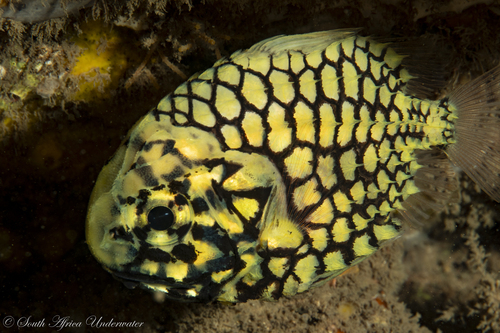
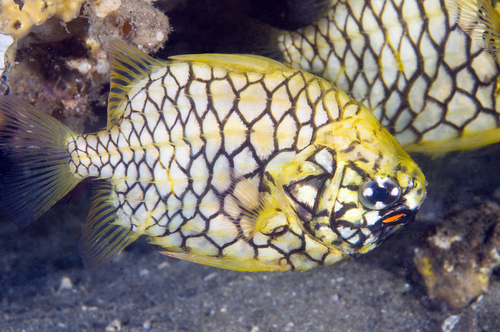
Cleidopus gloriamaris, commonly called the pineapplefish, grows up to 22 cm (8.7 in) long. It has a plump, rounded body almost entirely covered in large, rough scales with sharp, backward-pointing spines. Its head is large, with mucous pits bordered by rough ridges, and is armored with heavy bone. The snout is blunt and overhangs the wide mouth. Tiny, thin teeth are present on the jaws, palatine, and vomer. Two pits holding bioluminescent bacteria are located on the lower jaw near the corners of the mouth; these pits are hidden when the mouth is closed. This photophore is green in young fish and becomes more red as the fish ages. The first dorsal fin is made of 5 to 7 strong spines, which are free of membrane and point alternatingly left and right. The second dorsal fin holds 12 soft rays. Each pelvic fin has an extremely large spine, nearly as long as the head, plus 3 to 4 rudimentary rays. The pelvic spine can be locked erect at a right angle to the body. The anal fin contains 11 to 12 rays, while pectoral fins have 14 to 15 rays. The pineapplefish's scales are yellow to whitish with black rear margins, creating the distinct pattern that gives the species its common name. The lips, chin, and parts of the jaw are black, and a red stripe runs along the lower jaw to the photophore. This species is very similar to pinecone fishes of the genus Monocentris, and some authors place it within that genus. Cleidopus differs from Monocentris in having a narrow preorbital bone, and in the position of its light organs: in Monocentris, light organs are located near the tip of the lower jaw. This species also differs from the Japanese pineapplefish (Monocentris japonica) by having a more rounded snout. The pineapplefish is native to coastal waters off Queensland, New South Wales, and Western Australia. It lives at depths between 6 meters (20 ft) and 200 meters (656 ft), in reefs and harbors. Because of its small fins and rigid armor, the pineapplefish is a weak swimmer. It is a nocturnal species; during the day it can be found inside caves and under rocky ledges. In the Fly Point Halifax Park Aquatic Preserve, New South Wales, a small group of pineapplefish has been recorded under the same ledge for at least seven years, and another group under a different ledge for three years. At night, the species travels out onto sandy flats to feed, using its light organs to illuminate small shrimp. Its light may also be used to communicate with other pineapplefish. The pineapplefish's light is produced by symbiotic colonies of the bacteria Vibrio fischeri inside its photophores. V. fischeri also lives free in seawater, and is naturally released from the pineapplefish's photophores. However, the bacteria's luminescence fades within a few hours after release. This species has been recorded to live up to 10 years in captivity.