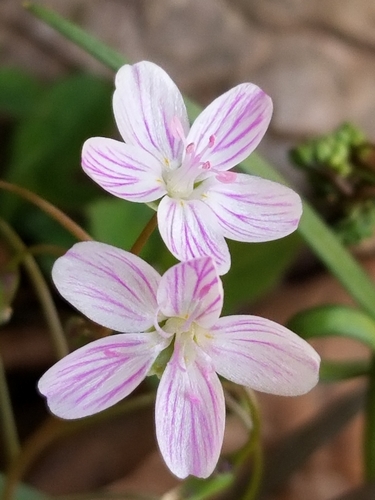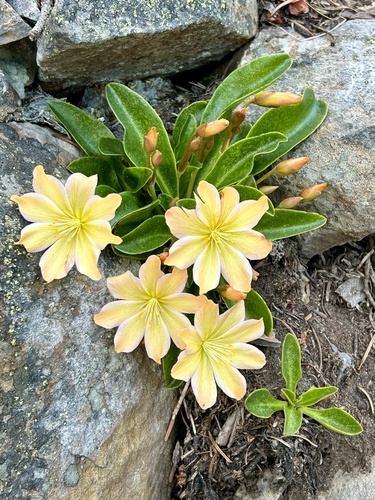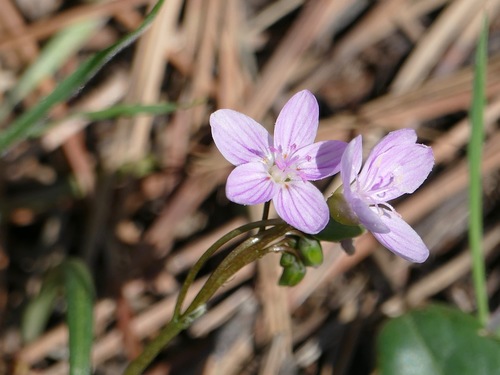
About Claytonia rosea Rydb.
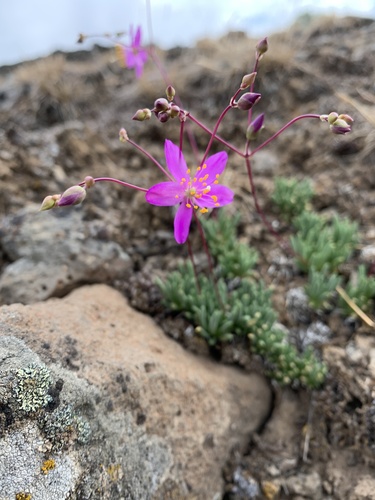
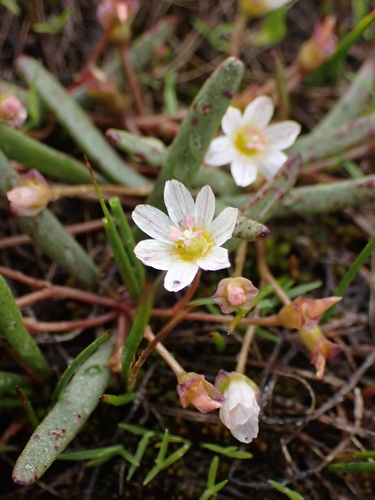
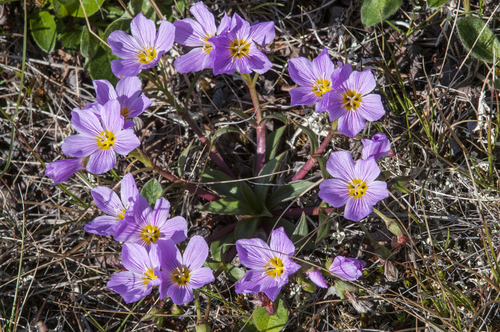
Claytonia rosea Rydb. grows from a small round tuber measuring 20–100 mm across, with a protective corky or woody outer skin 5–10 mm thick. Its stems range from 2–15 cm (0.8–6 in) long, and are entirely absent when the plant is not large enough to produce flowers. Young plants produce basal leaves that rise directly from the soil on individual petioles; these leaf blades are linear to narrowly spatulate, 1–7 cm (0.39–2.8 in) long and 0.4–2 cm (0.2–0.8 in) wide. This narrower shape helps distinguish C. rosea from the related Claytonia lanceolata, which has wider leaves. Additionally, C. rosea leaves are single-ribbed or indistinctly triple-ribbed, in contrast to the distinctly triple-ribbed leaves of C. lanceolata. When the plant is mature enough to flower, basal leaves may be absent, and instead several leaf-like bracts attach to the flowering stem. These bracts share the same linear blade shape, and measure 2–5 cm (0.8–2 in) long. All leaves and bracts have a pointed tip that may be slightly acute or obtuse, and they are fleshy and succulent, rather than leathery.
Claytonia rosea is the earliest spring-blooming flower in foothills and montane forests. It grows in small meadows, open hillsides, canyons, ravines, and mesas within montane ponderosa pine, Chihuahuan pine, and oak belts. In New Mexico, it is reported to occur more often on north-facing slopes or in shaded canyons. It has been recorded growing at elevations from 800–2,400 meters (2,600–7,900 ft). The exact full range of C. rosea is uncertain, as different botanical authorities report different distribution areas. Plants of the World Online (POWO) records it in the Four Corner states of Colorado, Utah, New Mexico, and Arizona in the United States, plus the Mexican state of Coahuila. The PLANTS database additionally records it as growing in Wyoming and Montana. NatureServe has assessed the global conservation status of Claytonia rosea as G4, meaning it is apparently secure: an uncommon but not rare species.
The first scientific observation of the sweat bee species Lasioglossum perpunctatum was collected from flowers of Claytonia rosea near Boulder, Colorado by T.D.A. Cockerell and Marion Durbin Ellis.
Commonly called Rocky Mountain spring beauty, this species is occasionally grown in rock gardens or by wildflower gardening enthusiasts. Replanted tubers will persist for a time even in less than ideal conditions, but they will decline without reproducing if planted in areas that experience extreme drying during summer or flooding during rainstorms. Gardeners propagate this plant by seed rather than by division. In garden settings, it prefers rich, well-drained soil. It tolerates being transplanted while it is actively blooming, and it freely self-seeds to produce new individuals.
The small tubers of Claytonia rosea are edible, though they are not usually abundant in the wild. Wild foods author Harold D. Harrington reported that raw tubers are crisp and starchy with very little flavor, while boiled tubers taste similar to earthy potatoes.