About Claytonia perfoliata Donn.
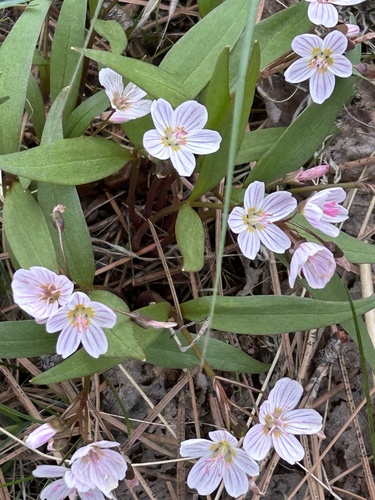
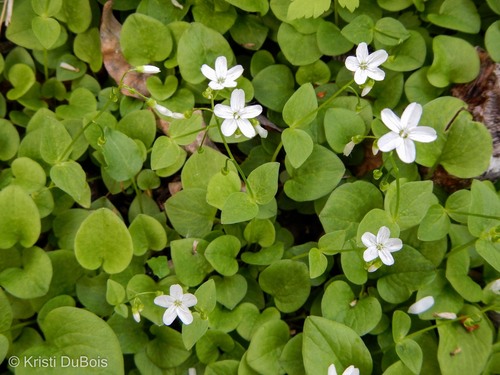
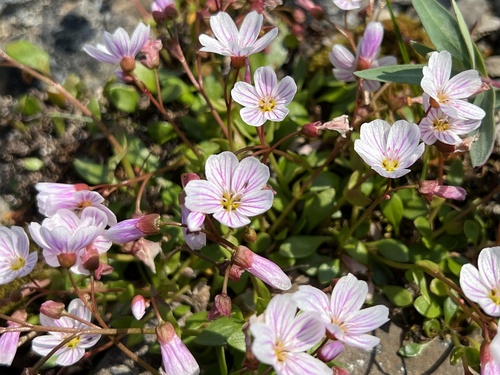
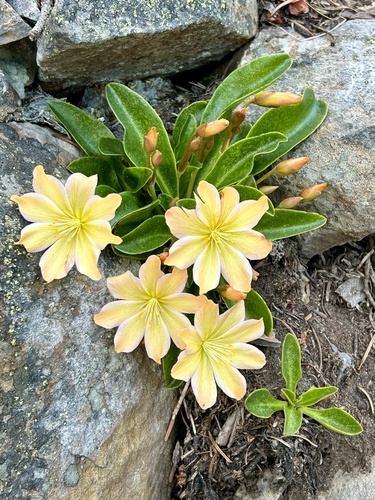
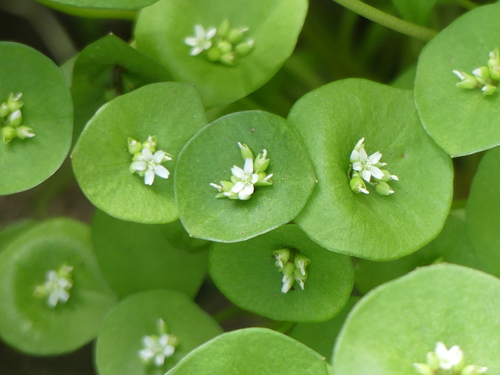
Claytonia perfoliata Donn. is a tender, rosette-forming plant that reaches around 30 centimeters (12 inches) in height, though mature plants can be as short as 1 centimeter (3⁄8 inch). Its cotyledons are typically bright green (rarely purplish-green or brownish-green), succulent, long, and narrow. The first true leaves form a rosette at the plant's base, measure 0.5 to 4 centimeters (1⁄4 to 1+5⁄8 inches) long, and usually have a long petiole, which can exceptionally reach 20 centimeters (8 inches) in length. Its small pink or white flowers have five petals that are 2 to 6 millimeters (1⁄16 to 1⁄4 inch) long. Flowers, which grow in clusters of 5 to 40, bloom from February through May or June. They grow above a pair of leaves that fuse together around the stem, appearing as a single circular leaf. Mature plants form a rosette and produce numerous erect to spreading stems that branch from the base. C. perfoliata is common in spring and prefers cool, damp conditions. It first emerges in sunlit areas after the year's first heavy rains, while the densest, healthiest stands grow in shaded upland areas into early summer. As weather becomes hotter and drier, the leaves turn deep red as they dry out. This species is native to Mexico and western North America, ranging north to British Columbia. It has been introduced and become widely naturalized in western Europe, Argentina, and New Zealand. It was brought to Europe in the 18th century, possibly by naturalist Archibald Menzies, who transported it to Kew Gardens in London in 1794. It was first recorded growing wild in Britain in South Hampshire in 1849, and it continues to spread across the region. As of 2019, the species has been observed growing as far inland as Arkansas. Its common name miner's lettuce comes from its use by miners during the California Gold Rush, who ate the plant to prevent scurvy. It is in season in April and May, and can be consumed as a leaf vegetable. All parts of the plant except the roots are edible, and it provides vitamin C. It is most often eaten raw in salads, but it is slightly less delicate than cultivated lettuce. It may also be boiled like spinach, which it resembles in both taste and chemical composition. Care should be taken when consuming wild C. perfoliata, as the plant can sometimes accumulate toxic amounts of sodium oxalate, a trait it shares with spinach. In the Ivilyuat language, the plant is called palsingat, and possibly lahchumeek. It was eaten fresh or boiled as a green by the Ivilyuqaletem (Cahuilla) people of Southern California. Along with Claytonia exigua, it can be gathered in early spring.