About Claytonia parviflora Douglas ex Hook.
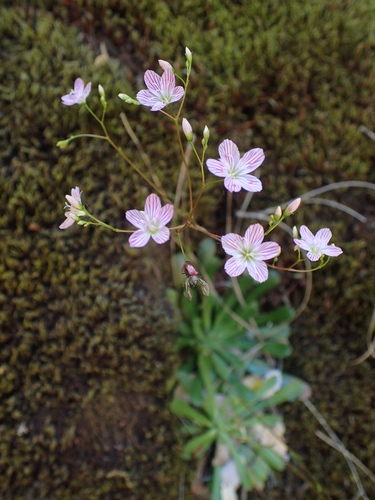
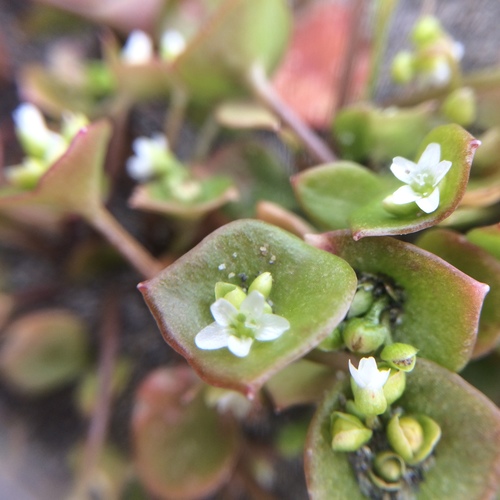
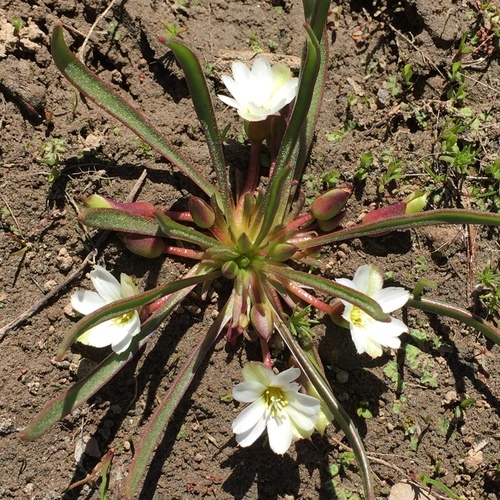
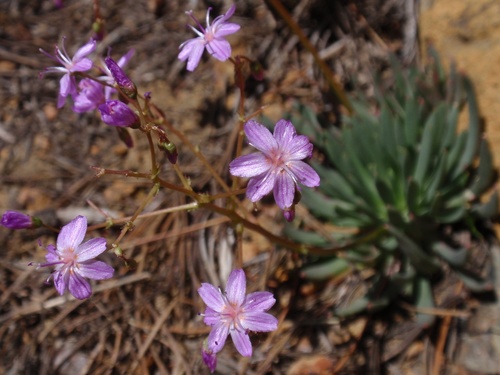
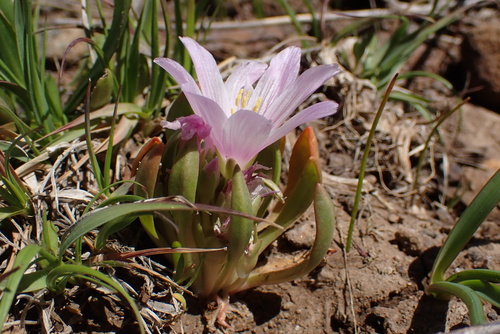
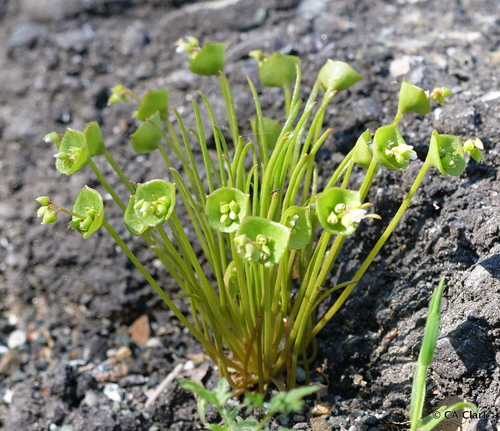
Claytonia parviflora is an annual herb that grows in clumps or spreads, reaching a maximum length of around 30 centimeters. Its basal leaves are linear, and often have an indistinct petiole. Some variants of this species may produce lance-shaped leaf blades on long, tapering petioles. This species also bears leaves along its flowering stem; these stem leaves can match the shape of the basal leaves, or be rounded or squared. Sometimes the stem leaves fuse together to form a bowl shape around the stem. The aboveground plant tissue ranges in color from green to pink. The inflorescence is a cluster of up to 40 small flowers. Each flower has petals a few millimeters long, colored white to pink-tinted or deep pink. The largest flowers, which reach up to 1 centimeter in diameter, occur in the subspecies Claytonia parviflora subsp. grandiflora, which is endemic to the foothills and lower slopes of the western Sierra Nevada in North America. Along with Claytonia perfoliata and Claytonia rubra, Claytonia parviflora forms what is almost certainly a polyploid pillar complex. Four well-defined subspecies of Claytonia parviflora are recognized: Claytonia parviflora subsp. grandiflora, Claytonia parviflora subsp. parviflora, Claytonia parviflora subsp. utahensis, and Claytonia parviflora subsp. viridis.