About Clavulinopsis laeticolor (Berk. & M.A.Curtis) R.H.Petersen
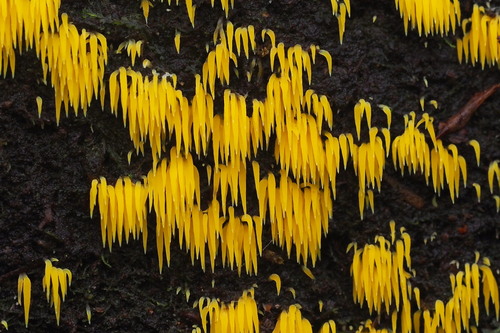
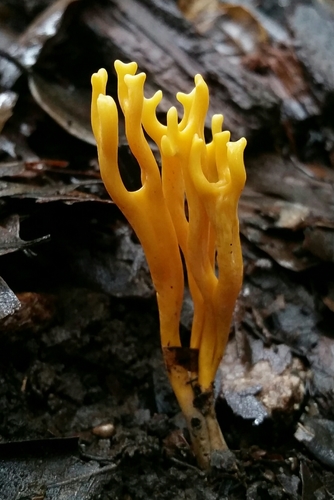
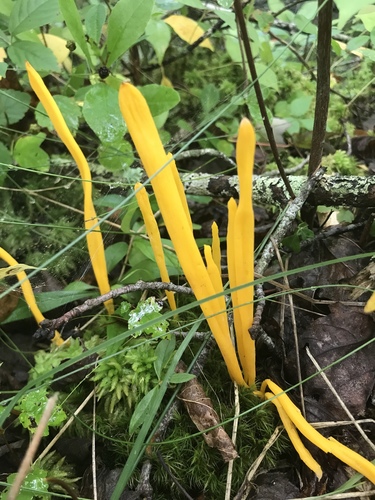
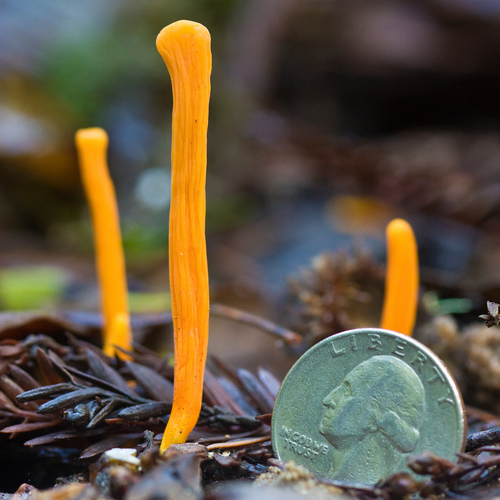
The fruit body of Clavulinopsis laeticolor ranges from cylindrical to narrowly club-shaped, measuring up to 100 mm (4 in) long and 10 mm wide. Its color ranges from lemon yellow to deep yellow, it has an indistinct stem, and the base of the fruit body is white. Under microscopic examination, its basidiospores are transparent (hyaline), ellipsoid in shape, measure 4.5 to 7 μm by 3.5 to 5 μm, and have a large, off-center apiculus. Clavulinopsis laeticolor was first formally described from Cuba. When considered in a broad sense as part of a complex of closely similar species, it has been reported from North America, Europe (reported there as C. pulchra), Malaya (reported there as C. pulchra), China, Australia (reported there as C. pulchra), New Zealand, Brazil, and Central and South America (reported there as C. pulchra). This fungus grows singly or in small clusters on the ground, and it is presumed to feed on dead organic matter as a saprotroph. In America and Asia, it grows in woodland, while in Europe it is generally found in unimproved agricultural short-sward grassland such as pastures and lawns. This type of waxcap grassland is a declining and threatened habitat, but Clavulinopsis laeticolor is one of the more common species in this habitat and is not generally considered a species of conservation concern.