About Clavulinopsis fusiformis (Sowerby) Corner
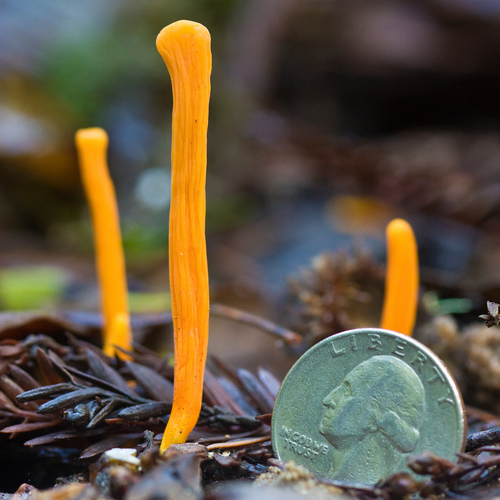
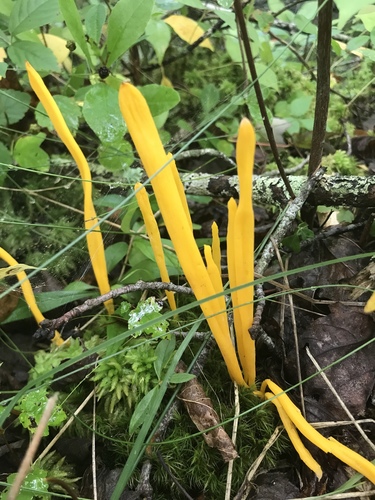
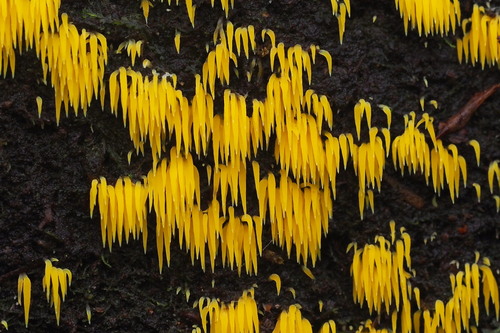
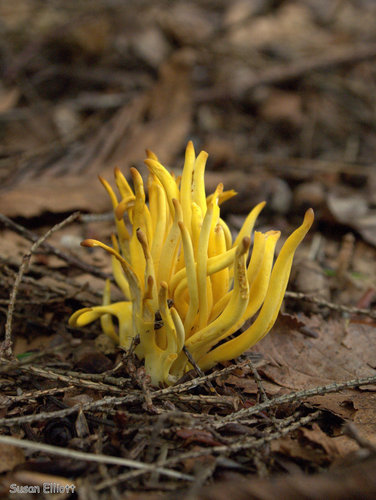
Clavulinopsis fusiformis produces bright yellow, cylindrical, unbranched finger-shaped fruit bodies that grow in densely crowded clusters. Individual fruit bodies can reach up to 11 cm (4+1⁄4 in) tall, and are less than 1 cm thick. Microscopically, its hyphae are hyaline, up to 12 μm in diameter, and have clamp connections. Its basidiospores are hyaline, smooth, and globose to subglobose, measuring 4.5 to 7.5 μm with a large apiculus. This species was first described from England and is common across Europe. Its distribution outside of Europe is uncertain, because it is frequently confused with similar closely related species that belong to the same species complex. Clavulinopsis fusiformis sensu lato has been reported from North America, Central America, South America, and Asia, including Iran, China, Nepal, and Japan. Clavulinopsis fusiformis typically grows in large dense clusters on the ground, and it is presumed to be saprotrophic. In Europe, it generally grows in agriculturally unimproved, short-sward grassland such as pastures and lawns. These waxcap grassland habitats are declining and threatened, but C. fusiformis is one of the more common species in these habitats and is not currently considered a species of conservation concern. Outside of Europe, Clavulinopsis fusiformis sensu lato can be found in woodland. In China, it is one of the dominant macrofungal species in Fargesia spathacea-dominated community forest at elevations between 2,600 and 3,500 metres (8,500–11,500 ft). In Nepal, where the fungus is locally called Kesari chyau, its fruit bodies are commonly collected and consumed. Extracts collected from Japanese specimens have been found to contain an anti-B red blood cell agglutinin protein.