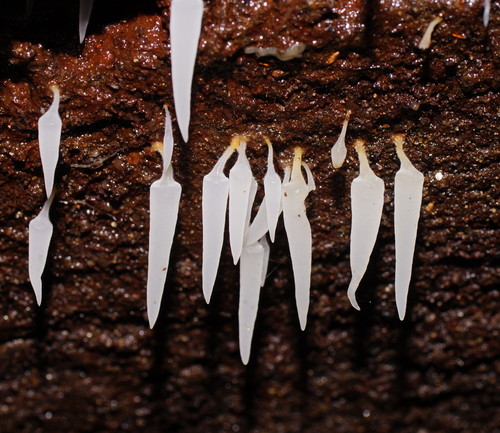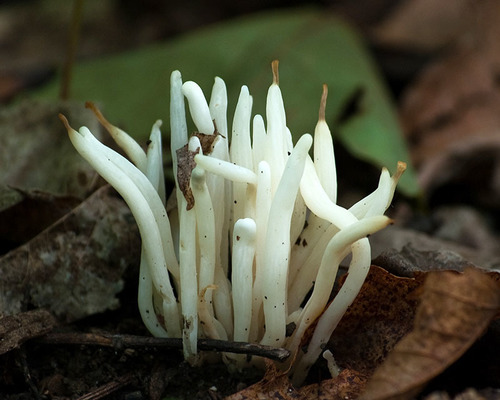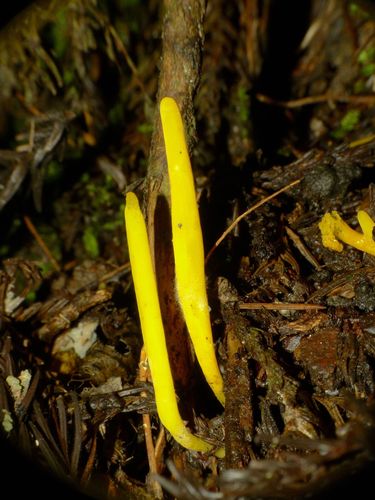
About Clavulinopsis corniculata (Schaeff.) Corner
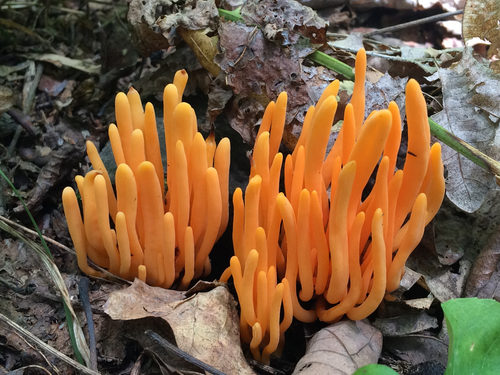
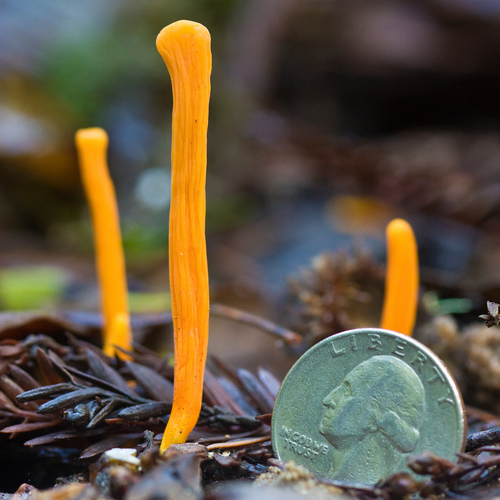
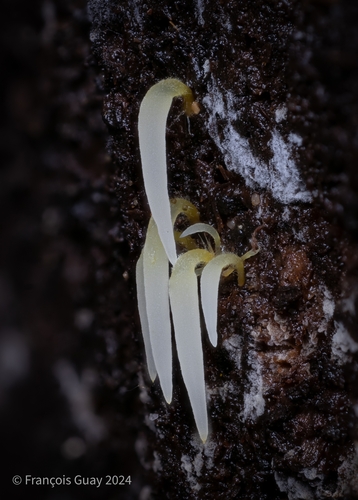
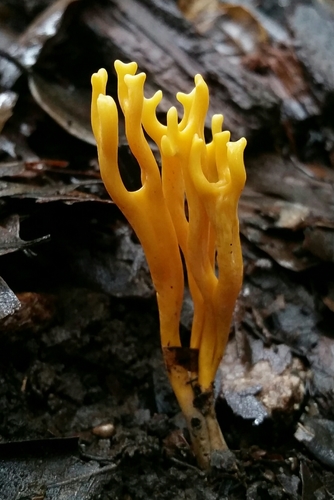
Clavulinopsis corniculata fruit bodies range in color from ochre to deep yellow, grow up to 8 centimetres (3 in) tall, and are typically branched two or three times, with a distinct, often paler stem. Microscopically, its basidiospores are hyaline, smooth, globose to subglobose, measuring 4.5 to 6 by 4.5 to 5.5 μm, with a large apiculus. The species was first formally described from Europe, with a recent epitype collected from Slovakia. It is widely distributed across Europe, and has also been reported from North America, Central America, South America, Africa, Asia, and Australia. Fruiting bodies occur singly or in troops on the ground, and the species is presumed to be saprotrophic. In the Americas and Asia it grows in woodland, while in Europe it generally grows in agriculturally unimproved, short-sward grassland such as pastures and lawns, fruiting from July to November. This type of waxcap grassland is a declining, threatened habitat, but C. corniculata is one of the more common species in this habitat and is not generally considered a species of conservation concern. Although it is too small to have significant culinary value, it is reported to be edible when fresh. Its bitterness is reduced through cooking, and it is best used mixed in as a garnish. It does not preserve well.