About Clavulina coralloides (L.) J.Schröt.
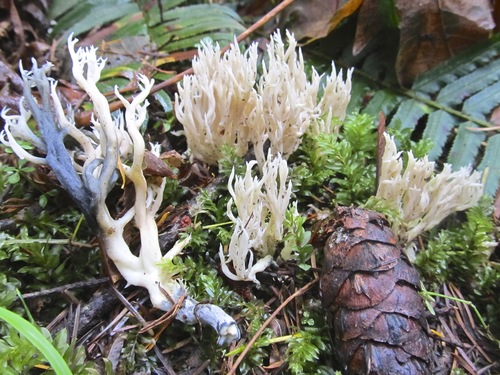
The fruit bodies of Clavulina coralloides are generally white to cream in color, and can reach up to 8 centimetres (3+1⁄8 in) tall, with a width of 2.5–4 cm (1–1+5⁄8 in). The coral-like branching arms of the fruit body are only sparsely branched, branching 3–4 times total. Individual arms are 2–4 mm wide, smooth, and sometimes develop longitudinal wrinkles. The tips of the arms are cristate, with small pointed projections, and often darken as the fungus ages or when conditions are dry. The stem of the fruit body varies in shape; it measures 5–40 mm (1⁄4–1+1⁄2 in) long and 5–20 mm wide. Fruit bodies have no distinctive odor, and a mild taste. Fruit bodies may develop a darker color from two causes: natural variation that makes the fungus closely resemble and easy to confuse with Clavulina cinerea, or infection by the microscopic fungus Helminthosphaeria clavariarum. In temperate regions, this species grows solitary or in clusters on the ground, sometimes on rotten wood, in both coniferous and hardwood forests. It is found in the Americas and Europe. On the west coast of North America, it fruits from October to March; further inland in North America it fruits from July to October, and in Europe it fruits from June to November. It is a common mushroom that typically fruits from late summer through winter. This fungus is edible. Its tough flesh and small, insubstantial fruit bodies make it unappetizing to some people, while others consider it excellent to eat.