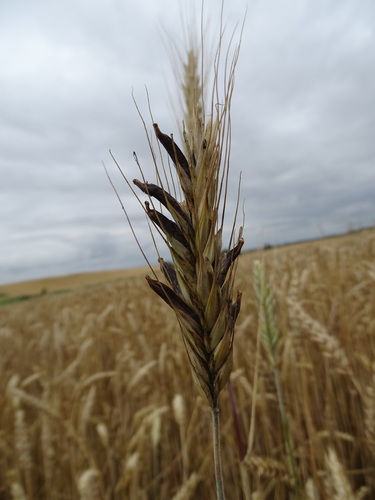
About Claviceps purpurea (Fr.) Tul.
Claviceps purpurea (Fr.) Tul. is an ergot fungus that grows on the ears of rye and related cereal and forage plants. If humans or other mammals consume grains or seeds contaminated with this fungus's survival structure, the ergot sclerotium, they can develop ergotism. C. purpurea most commonly affects outcrossing species, with rye being its most common host. It also affects triticale, wheat, and barley, and only rarely affects oats. The life cycle of C. purpurea begins when an ascospore of the fungus infects a floret of a flowering grass or cereal, forming an ergot kernel called Sclerotium clavus. The infection process mimics a pollen grain growing into an ovary during fertilization. Because infection requires the fungal spore to reach the stigma, plants infected by C. purpurea are mainly outcrossing species with open flowers, such as rye (Secale cereale) and Alopecurus. After infection, the proliferating fungal mycelium destroys the plant ovary and connects to the vascular bundle that originally would supply nutrients to a developing seed. The first stage of ergot infection produces a white soft tissue called Sphacelia segetum, which makes sugary honeydew that often drips out of infected grass florets. This honeydew contains millions of asexual spores called conidia, which spread to other florets via insects or rain. Over time, Sphacelia segetum transforms into a hard dry Sclerotium clavus inside the floret husk. At this stage, alkaloids and lipids such as ricinoleic acid accumulate in the sclerotium. When a mature sclerotium falls to the ground, the fungus stays dormant until proper conditions (such as the start of spring, a rain period, or required cool winter temperatures) trigger its fruiting phase. The dormant sclerotium germinates and forms one or more fruiting bodies with a head and stipe, which vary in color and resemble tiny mushrooms. Threadlike sexual spores called ascospores form inside perithecia in the head, and all ascospores are ejected at the same time when suitable grass hosts are flowering. Ergot infection reduces both the yield and quality of grain and hay. If infected grain or hay is fed to livestock, the animals can develop ergotism. The social wasp species Polistes dorsalis has been recorded as a vector that spreads C. purpurea. When these wasps forage, fungal conidia particles stick to parts of their bodies. As P. dorsalis moves between sites, it leaves the fungus behind to cause new infections. Other insects including flies and moths have also been found carrying conidia of Claviceps species, but it remains unknown whether insects play a general role in spreading the fungus from infected plants to healthy plants.

