About Clavariadelphus ligula (Schaeff.) Donk
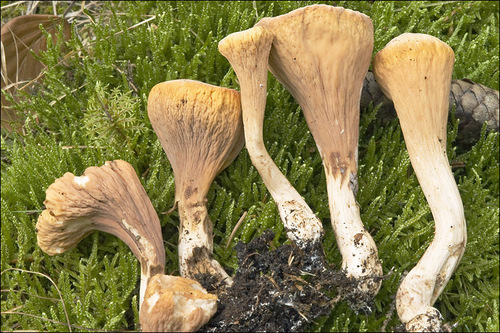
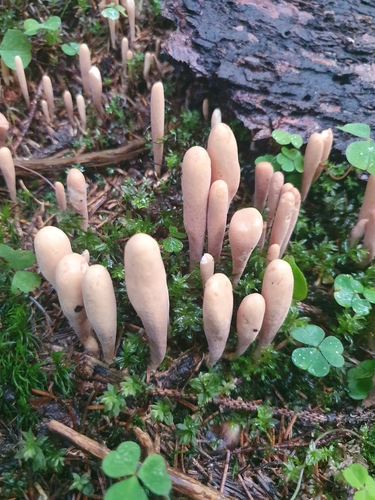
The club-shaped portion of the fruit body of Clavariadelphus ligula ranges in color from buff to pale yellow or reddish, is straight, and has stiff hairs at its base. The surface is dull, hairless, smooth when young, and becomes somewhat wrinkled as it matures. Fruit bodies are shaped like clubs or spoons, and reach up to 12 cm (4.7 in) tall and 2 cm (0.8 in) wide at their thickest point. The stipe is not distinct from the rest of the fruit body, aside from the stiff hairs at the base. The flesh is whitish and does not change color when bruised. It is somewhat spongy in the upper section of the fruit body, but firm lower down. The flesh has no odor, and a slightly bitter taste. When a solution of ferric sulphate is applied to the surface tissue, it turns green; when a dilute potassium hydroxide solution is applied, it turns yellow. Spore deposits are pale yellowish orange, or light buff. Additional features observable under light microscopy include smooth, narrowly ellipsoid spores that measure 8–15 by 3–6 μm. The hyphae are monomitic, clamp connections are present, and cystidia are absent. Some field guides list this species as edible, while other field guides categorize it as inedible. Fruit bodies of C. ligula grow gregariously, meaning closely scattered across small areas, on the ground in forest duff. It is widespread and common in coniferous forests, and produces fruit bodies in summer and fall. The species has been collected in the Czech Republic, Austria (data included), the Magadan region of the Russian Far East, the arctic zone of the Urals, conifer-dominated forests in Kashmir Valley, India, and in North America as far north as Canada.