About Clavaria zollingeri Lév.
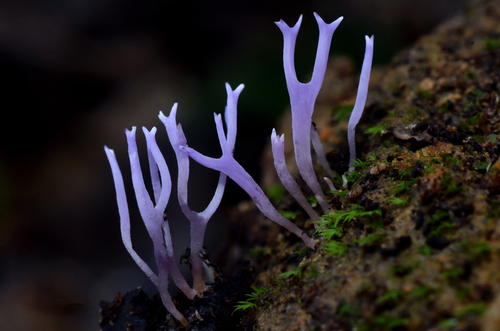
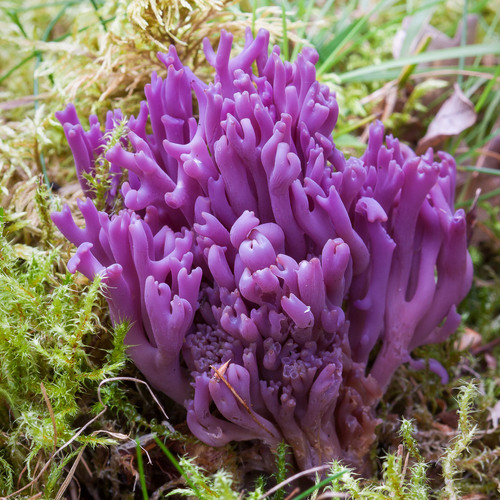
The fruit bodies of Clavaria zollingeri Lév. are quite variable in color, ranging from violet to amethyst, or violet shaded with brown or red. Color can vary across different parts of a single fruit body; in one recorded case, outer branches were brown while inner branches at the center of the bundle were light violet. Dried specimens may lose almost all of their original color, because the pigments in this fungus are sensitive to light and dryness. Mature fruit bodies typically measure 5 to 10 cm (2 to 4 in) tall and 4 to 7 cm (1+1⁄2 to 2+3⁄4 in) wide. The stem (base) is short, and branching begins a short distance above ground. The fragile branches have smooth, dry surfaces, measure 2–6 units thick, and usually have rounded tips. This species has no distinguishable odor, and its taste is somewhat similar to radishes or cucumber. Spores, which are produced on the surface of the branches, are white in mass. Under light microscopy, spores are roughly spherical to broadly elliptical, with dimensions of 4–7 by 3–5 μm. Each spore has a clear apiculus about 1 μm long, and a single large oil droplet. The four-spored spore-bearing basidia lack clamps, measure 50–60 by 7–9 μm, and gradually widen at the apex. Fruit bodies of Clavaria zollingeri grow singly, in scattered groups, or in clusters on the ground in grassy locations. They are usually found near hardwood trees, or growing with mosses. This is a saprobic species, which gets nutrients by breaking down organic matter. It has a widespread distribution, and has been recorded in Australia, New Zealand, North America, South America, and Asia, specifically including Brunei, India, and Korea. In North America, its distribution is mostly restricted to the northeastern regions of the continent, though isolated populations have been found as far south as Northern Arkansas. It is rare in Europe, and is listed on the Red Lists of threatened species in Denmark and Great Britain. In Ireland, it is used as an indicator species to assess fungal diversity in threatened nutrient-poor grassland habitats. It was first recorded in the Netherlands in 2006.