About Clavaria fragilis Holmsk.
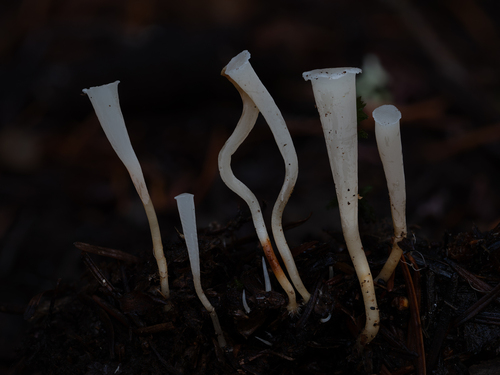
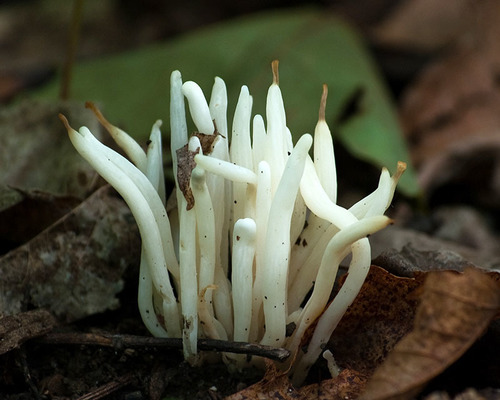
Clavaria fragilis Holmsk. produces fruit bodies that are irregularly tubular, with a texture ranging from smooth to furrowed, and are sometimes compressed. They are very fragile, white in color, and grow up to 15 cm (6 in) tall and 7 mm (1⁄4 in) thick. Fruit bodies typically grow in dense clusters. The tip of each fruit body tapers to a point, and may turn yellow and curve as it ages. There is no clearly defined stalk, though a short, semitransparent zone of tissue at the base of the club is recognizable as a stalk-like region. Microscopically, the flesh hyphae are swollen up to 12 μm wide and do not have clamp connections. The spores are smooth, colorless, and shaped from ellipsoid to oblong, with dimensions of 5–7 by 3–4 μm. Spore deposits are white. The spore-bearing basidia measure 40–50 by 6–8 μm, and also lack clamps at their bases. This species occurs across the Northern Hemisphere, including Europe (where it can be found from July to October), Asia, and North America. In North America, it is more common east of the Rocky Mountains. It has also been recorded growing in Australia and South Africa. In 2006, it was reported from the Arctic zone of the Ural Mountains in Russia. The fungus grows in woodland and grassland on moist soil, and is presumed to be saprobic, breaking down fallen leaf litter and dead grass stems. Its fruit bodies usually grow in groups, tufts, or clusters; while they can grow singly, they are typically hard to spot unless they grow in clusters.