About Clathrus archeri (Berk.) Dring
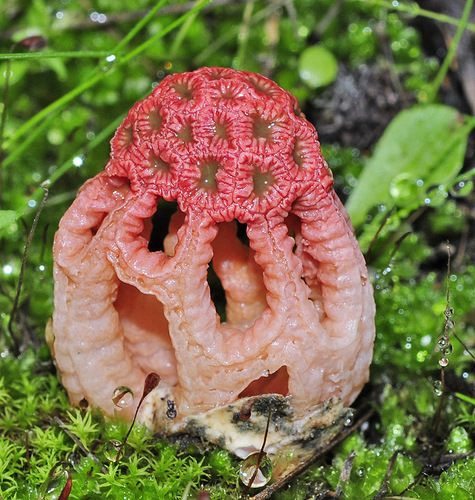
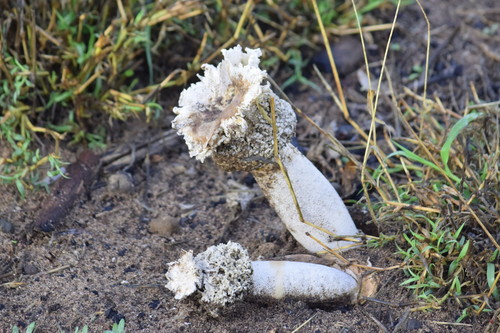
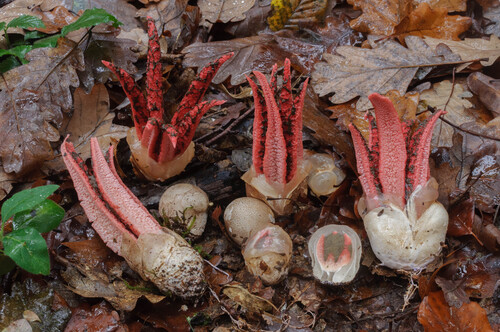
Clathrus archeri (Berk.) Dring grows in two distinct life stages, beginning with an egg stage before its fungal "arms" emerge. In the first stage, it forms a white, ball-like egg that is usually 2–3 cm (3⁄4–1+1⁄8 in) in diameter. Next, the thallus emerges from the egg in a starfish-like shape, with an average of 4 to 6 arms (and up to 8 arms total). Each arm can reach 10 cm (4 in) in length, and its upper surface is coated in gleba. Fruiting bodies are red-orange in color, a pigment produced by carotenoids. Its spores are oblong, smooth, and measure 3.5–6 by 1.5–2 μm. Like other members of the family Phallaceae, the strong putrid odor of its gleba is an example of convergent evolution with a group of angiosperm flowers called sapromyophilous flowers. In laboratory settings, C. archeri grows best at 26 °C (79 °F) on compost agar medium with a pH of 6.0. Under these conditions, the thallus grows an average of 2.9 mm (1⁄8 in) per day over four weeks, in a radial pattern. C. archeri produces white, fluffy mycelium that eventually turns pink. Mycelial strands are 0.5–1.5 mm (1⁄64–1⁄16 in) in diameter and branch in a tree-like pattern. The fungus's hyphae form irregularly shaped vesicles that contain lipids. Calcium oxalate crystals are secreted onto the surface of the hyphae; it is hypothesized that this outer layer of crystals forms a protective hydrophobic layer around the hyphae. C. archeri forms unstable perforate septal pore caps, which may suggest that perforation development in Phallomycetidae occurs later than in similar groups. Clathrus archeri is commonly found in environments with abundant decaying organic matter. It is most often found growing in leaf litter and mulch, in both woodlands and grasslands. As a saprophyte, it prefers areas with high moisture, access to oxygen, neutral pH, and low to medium temperatures. The species is thought to be endemic to southern Africa, New Zealand and Australia, but has spread to other continents and is often invasive. It now has a global distribution, and has become naturalized in Europe and North America. It was first recorded in the United Kingdom over a century ago, around 1914, and has since spread across most of Europe. It was likely introduced to Europe via wool fabric in World War I supplies. As climate change causes niche habitat loss, Clathrus archeri is expected to become a threatened species in Australia, but is predicted to expand its range into northeast Europe. Its expansion in Europe is further supported by its invasion of two new sites in Romania in July 2013. As of 2013, Clathrus archeri has been recorded at 90 sites in Poland, 65% of which are located in forests. Recent modeling studies in Poland predict this alien species will occur in areas with a thick layer of snow that does not melt in winter, at higher altitudes, where water deficit is low. Recently, a variety Clathrus archeri var. alba, which has white tentacle-shaped arms, has been reported from Shola Forests in the Western Ghats, Kerala, India. Clathrus archeri grows best in environments rich in decaying vegetation. It is a saprotrophic fungus, most commonly found growing in leaf litter or mulch beneath vegetation. The most abundant acid secreted by the fungus is oxalic acid, which binds to metal cations and increases the bioavailability of some minerals. The fungal mycelium accumulates calcium, which changes soil pH and the availability of phosphorus for surrounding plants. Clathrus archeri disperses its spores via carrion-seeking flies: the fungus produces a decaying flesh odor that mimics decomposing animal tissue. This olfactory mimicry attracts insects, which unknowingly carry spores to new habitats.