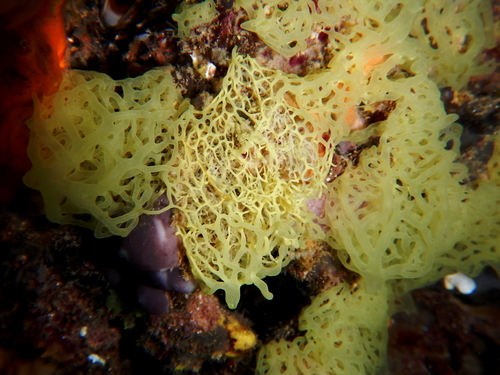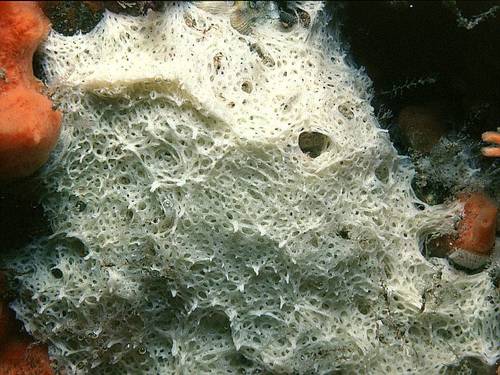
About Clathrina coriacea (Montagu, 1814)
Clathrina coriacea (Montagu, 1814) is a species of calcareous sponge that belongs to the class Calcarea and family Clathrinidae. All species in the genus Clathrina have calcium carbonate tube-like skeletons that contain spicules. This sponge is found in shallow waters and is widely distributed along North Atlantic coasts, as well as other coasts around the world. This species occurs along east Atlantic coasts, ranging as far north as the Arctic and as far south as South Africa, though it is most well-documented in the North Atlantic and around the coasts of the British Isles. Specimens found in the Ligurian Sea have purple spots across their surface; these spots form from a web of fungal hyphae. This is largely a shallow-water species, though it has been recorded at depths of up to 650 meters. It most often grows on rock substrates, but it is also common on kelp holdfasts and on the surface of other sponge species. It is typically found alongside Dendrodoa grossularia in caves and canyons, but it can also grow on shore rocks. It can occur in dense aggregations with Dendrodoa in gullies and tunnels that experience regular wave surges, and it can also be found growing on mud banks. The reproductive season of Clathrina coriacea runs from July through October, covering the summer and fall months. This species can reproduce both asexually and sexually, and it is hermaphroditic. It undergoes fragmentation during the summer, and its reproduction is influenced by environmental factors including temperature. Oogenesis is common in this species, and it displays total cleavage that produces a blastula larva with one posterior granular cell. While the larva is still inside the parent, its blastomeres migrate into the blastocoel. Adult individuals must reach a minimum size before they can reproduce. External buds have been observed on this species in prior studies.