About Clathria prolifera (Ellis & Solander, 1786)
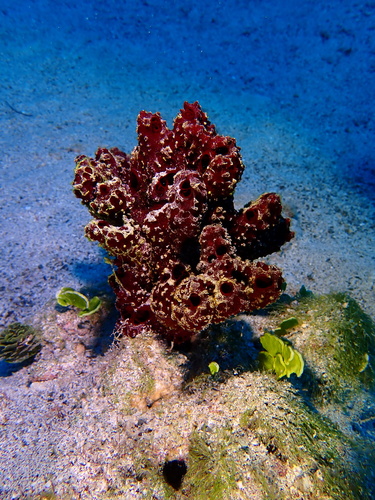
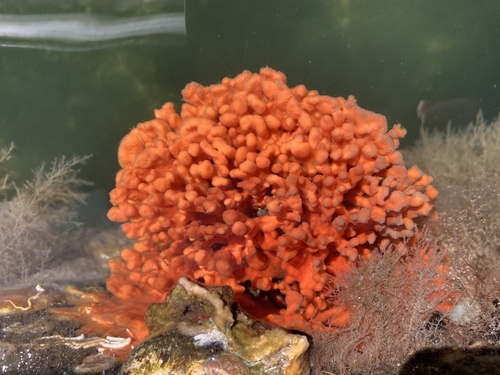
Clathria prolifera has an encrusting base that can be up to 20 cm (8 in) across and less than 3 mm (0.12 in) thick. It grows into bushy masses up to 20 cm (8 in) tall, made up of orange or red branches that are up to 6 mm (0.24 in) thick. These branches look like fingers, or they may join together to form folded sheets that resemble fans or drapery. Its spongy surface is covered with tiny pores that draw water into the sponge. This sponge was first described in 1786 by British naturalist John Ellis and Swedish naturalist Daniel Solander, from specimens collected in New Jersey. In the western Atlantic Ocean, it is found from Nova Scotia and Prince Edward Island southward to Florida, Mexico, and Brazil, though populations in the southern part of this range may actually belong to a different species. It was first recorded in the eastern Pacific Ocean in San Francisco Bay, California, in the 1940s, then in Willapa Bay, Washington state in 1967, and in Humboldt Bay, California in 1989. It likely arrived in the Pacific either as a fouling organism growing on a vessel's hull, or as a stowaway in a shipment of oyster spat. It grows on the underside of rocks and boulders in intertidal and subtidal zones, on docks and quays, and within oyster beds. It occurs in estuaries, bays, and harbours, where it can survive in waters with salinities as low as 15 ppt. Like all other sponges, Clathria prolifera draws water in through its pores and filters out planktonic particles that it uses as food. It releases larvae in summer and autumn. The larvae initially rise to the water surface, but after one or two days they sink to the bottom and crawl across the substrate until they find a suitable place to settle. Juvenile sponges start out as encrusting forms. Clathria prolifera is sometimes used as a model organism. Samples collected from Chesapeake Bay hosted a diverse community of associated bacteria, including members of the phyla Pseudomonadota, Bacteroidota, Actinomycetota, and Cyanobacteria. This bacterial community was distinct from the bacterial community found in the surrounding water. After the sponge was grown in aquaculture for six months, the composition of its associated bacterial community had changed significantly.