About Clarkia dudleyana (Abrams) J.F.Macbr.
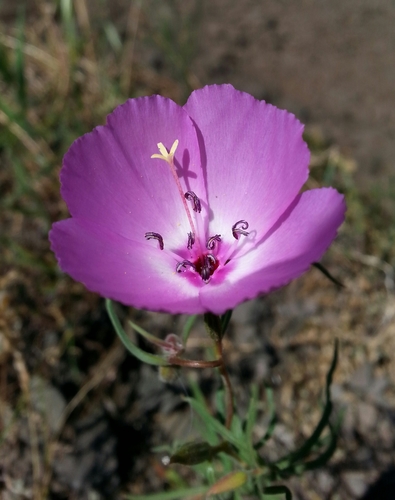
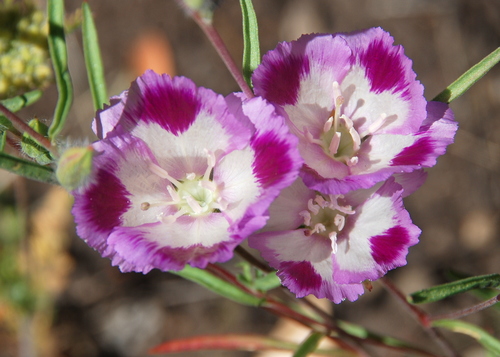
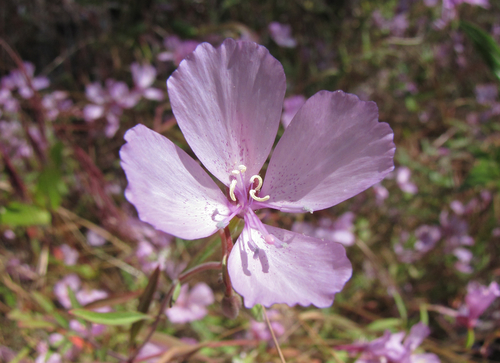
Clarkia dudleyana, a species of flowering plant in the evening primrose family, is commonly known as Dudley's clarkia. This species is endemic to California, where it occurs in the mountains of the Transverse Ranges and the southern Sierra Nevada foothills. It grows in woodland, forest, and chaparral habitats at elevations below 1,500 meters. Clarkia dudleyana is an annual herb that produces an upright stem, which sometimes grows taller than half a meter. Its leaves are lance-shaped, reach up to 7 centimeters in length, and are borne on short petioles. The stem ends in an inflorescence that holds open flowers below closed, hanging buds. When the flower blooms, its pink to reddish-purple sepals stay fused, and only open along one side. The petals are up to 3 centimeters long, fan-shaped, and pinkish lavender in color, and are sometimes flecked with red. The flower has 8 stamens: some have large lavender anthers, while others have smaller, paler anthers. The stigma extends further out than the stamens.