About Clarias batrachus (Linnaeus, 1758)
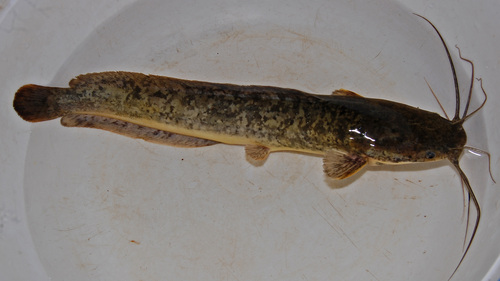
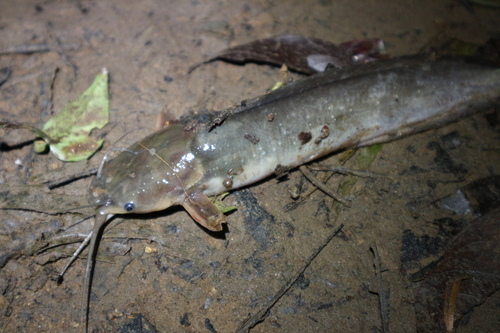
Characteristics and anatomy: The walking catfish, Clarias batrachus, has an elongated body, reaching up to nearly 0.5 m (1.6 ft) in length and 1.2 kg (2.6 lb) in weight. Its body is primarily gray or grayish brown, often marked with small white spots along its sides. It has long-based dorsal and anal fins, plus several pairs of sensory barbels. Its skin has no scales, but is covered in mucus that protects the fish when it is out of water. This fish must be handled carefully when caught, because it has an embedded, thorn-like defensive stinging structure hidden behind its fins, including the median fins located before the tail fin, a feature shared with most other catfishes. Taxonomy, distribution, and habitat: The walking catfish is a tropical species native to maritime Southeast Asia. The confirmed native range of true Clarias batrachus is limited only to the Indonesian island of Java. Three closely related, more widespread species are very frequently confused with this species: C. magur from northeast India and Bangladesh, one putative undescribed species from Indochina, and another putative undescribed species from the Thai-Malay Peninsula, Sumatra, and Borneo. Both of these undescribed forms are referred to as Clarias aff. batrachus. Currently, the taxonomic status of the Philippines population (called hito, or simply "catfish" by local people) is unresolved, and it is also unclear whether populations in South India are C. magur or a separate species. Because of this widespread confusion, much existing information about C. batrachus—covering behavior, ecology, introduced populations, and more—may actually refer to the closely related species that have been misidentified as true C. batrachus. True C. batrachus, C. magur, and the two putative undescribed species are all farmed via aquaculture. Walking catfish thrive in stagnant, often low-oxygen waters, and are most often found in muddy ponds, canals, ditches, and similar habitats. The species spends most of its time on or just above the bottom, only occasionally moving to the surface to gulp air. As food: In Indonesia, this fish is commonly called lele; when distinction is needed, it is called lele jawa or lele kampung, to differentiate it from lele dumbo or lele sangkuriang, which are the names used for the introduced species C. gariepinus. It is the main ingredient in several traditional Indonesian dishes, including pecel lele and mangut lele. In Thailand, Clarias aff. batrachus is known as pla duk dan (Thai: ปลาดุกด้าน). It is a common, inexpensive food that can be prepared in many different ways, and is often sold by street vendors, typically grilled or fried. This fish is also one of the most common freshwater catfish in the Philippines, where it is known locally as hito as noted earlier. Even so, the relationship between Clarias aff. batrachus populations from other regions of Southeast Asia and India and true C. batrachus has not been thoroughly studied to date.