About Clanculus plebejus (R.A.Philippi, 1851)
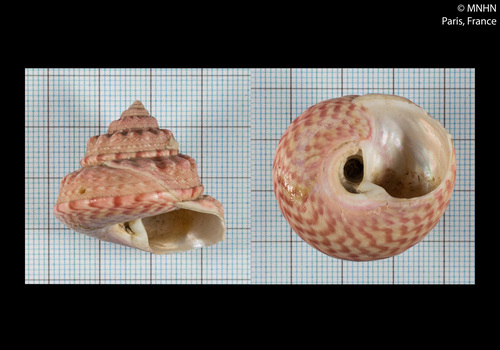
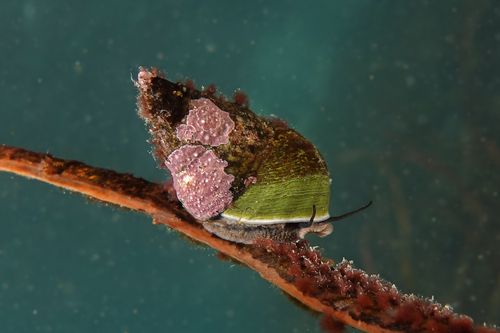
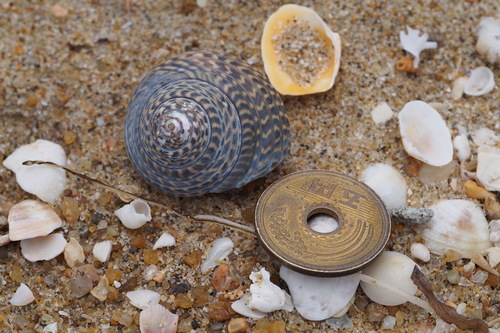
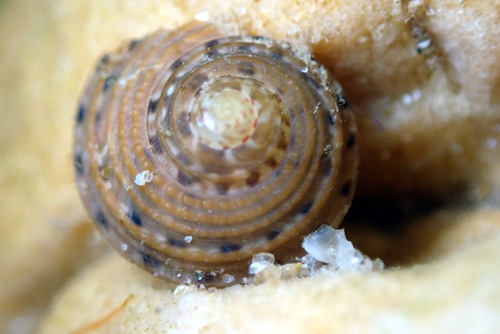
Clanculus plebejus (R.A.Philippi, 1851) is a marine gastropod species. The shell of this species ranges in size from 6 mm to 11 mm. The small shell is depressed and umbilicate, with a base color that can be pinkish brown, gray, or yellow. Its ribs are marked with articulated black and white dots; these dots often form radiating lines on the upper shell surface, and zigzag patterns on the underside, where the base color is yellow instead of pink. The spire is low-conic, with an acute apex. There are approximately 5 coarsely lirate whorls, with subcanaliculate sutures. The body whorl has an obtusely angular periphery. The upper surface of the body whorl is encircled by 4 coarse, somewhat beaded lirae. The top two of these lirae are contiguous, the third is separated by wide intervals both above and below it, and the fourth sits at the periphery, usually formed of two closely placed ridges. The interstices between these lirae hold numerous fine spiral striae and sharp microscopic incremental striae. The convex base of the shell is concentrically sculptured with 6 to 9 smooth striae, and very numerous microscopic striulae run between these striae in a circular pattern. The aperture is rounded and oblique. The outer and basal margins are thickened and very minutely crenulated on the interior. The columella is oblique, not tortuous at the upper end, and does not enter the umbilicus; instead it is inserted onto the side of the umbilicus. Its front edge is nearly straight, and denticulate at the base. The umbilicus is wide and not very deep, with a somewhat denticulate margin. This species is endemic to Australia, where it is found off the coasts of New South Wales, South Australia, Tasmania, Victoria, and Western Australia.