About Clanculus maugeri (W.Wood, 1828)
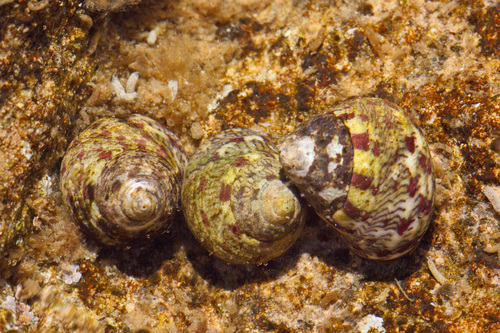
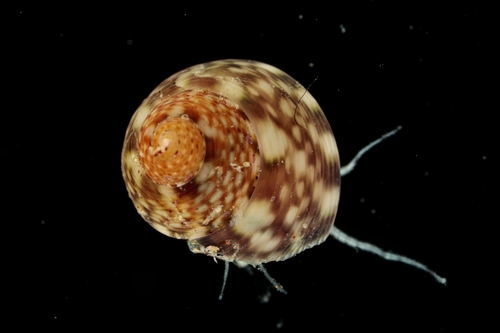
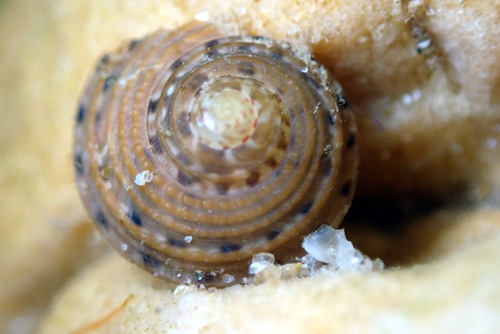
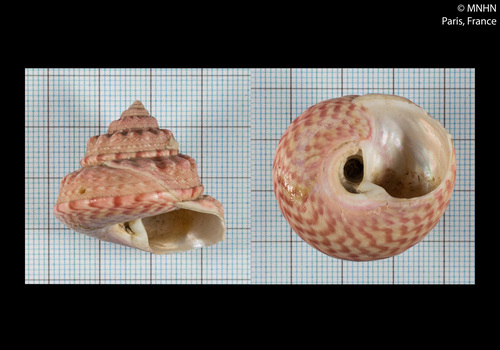
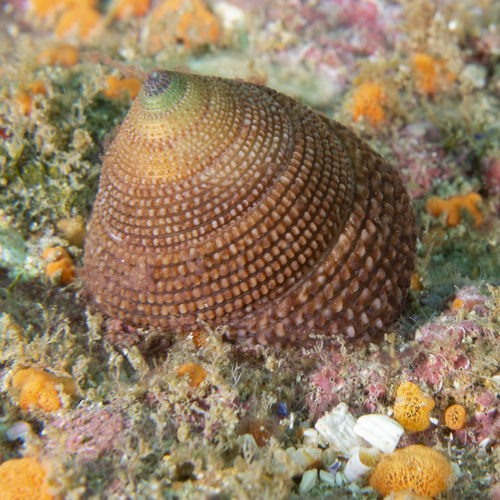
The shell of Clanculus maugeri has a height ranging from 20 mm to 26 mm, with a diameter of 25 mm. This solid, thick shell has a conical shape that is carinated, has nearly straight sides, and is false-umbilicate. Compared to most other species in the genus Clanculus, this species is more strictly conical. Its shell is colored reddish or yellowish-brown, with fine minute dots of a slightly darker shade scattered across the surface in varying quantities. There are approximately 8 whorls, which are flat on the upper side, and their sutures are barely noticeable. When the earliest apical whorls have not been eroded to smoothness, they are marked with spiral lirae that are dotted with red. The later whorls are covered in very fine, closely packed granules arranged in spiral rows, with nearly uniform fine granulation across the surface. The shell has minute darker dots, and usually also has minute white dots on the underside. These features distinguish Clanculus maugeri from other species within the genus Clanculus. The body whorl has roughly 7 rows of granules on its upper section, is carinated at the periphery, and curves slightly forward anteriorly. The base of the shell is nearly flat, with 15 to 20 closely spaced, fine beaded concentric lirulae. The aperture is tetragonal and very oblique. The upper lip is straightened and wrinkled on its inner surface. The outer and basal lips are thick, curved, and crenulate on their inner surface. The columella is very oblique. Its edge is denticulate, slightly winding near the top, and inserted at the center of the axis. At the bottom, it ends in an acute or squarish narrow tooth. The parietal wall and umbilicus are both rugose, and the umbilicus is bordered by a plicate-denticulate rib. This is a marine species endemic to Australia, found in intertidal and subtidal zones off the coasts of New South Wales, Tasmania, and Victoria.