About Clanculus limbatus (Quoy & Gaimard, 1834)
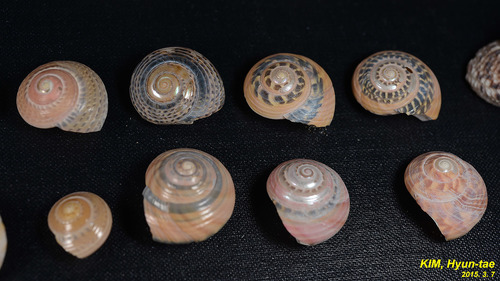
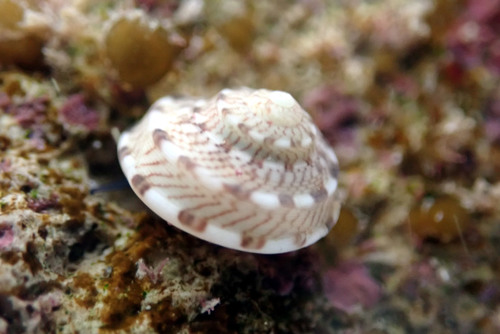
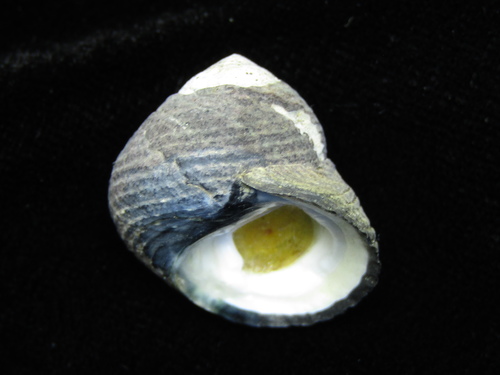
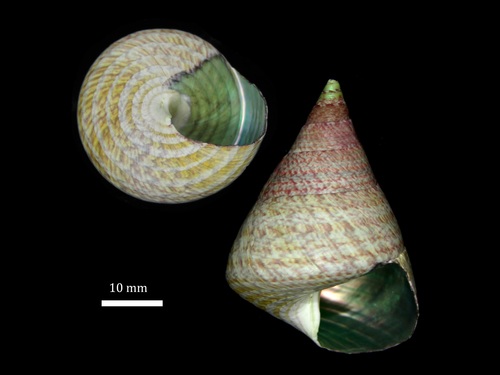
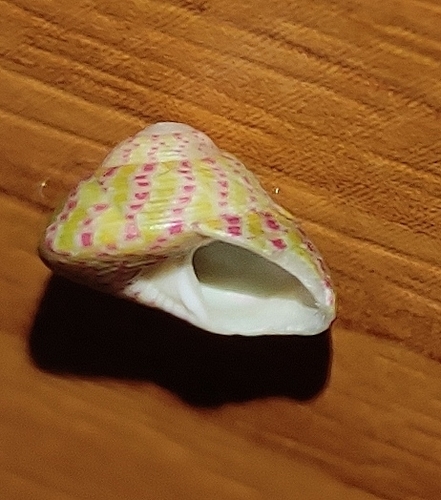
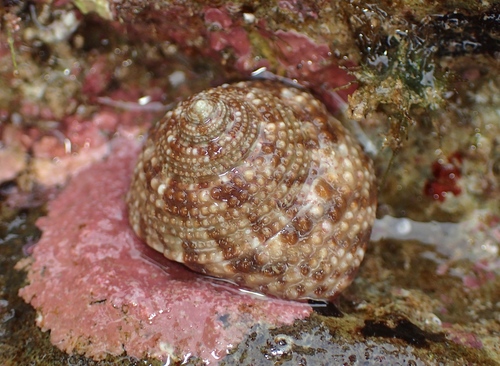
This species is the sea snail Clanculus limbatus, first described by Quoy & Gaimard in 1834. The shell of this species ranges in size from 13 mm to 20 mm. It is a depressed, umbilicate shell with a conoidal shape, and it bears a keel (carina) at its periphery. The shell is whitish or yellowish in color, marked with irregular brown patches. It typically has a row of these brown patches at the periphery and just below the suture, and the area between these two rows is either uniformly colored or displays a more or less distinct checkered (tessellated) pattern. The base of the shell is either tessellated or marked with radiating flame-shaped brown markings. The spire is low and conical, ending in an acute, smooth apex. The shell has 5 to 6 whorls: each whorl is convex just below its suture, then becomes flattened toward the periphery, where it is carinated. The sutures between the whorls are shallowly grooved (subcanaliculate). The body whorl barely slopes downward toward the aperture, and it bears 6 to 8 closely spaced, granular spiral ridges (cinguli) on its upper surface, plus 7 to 9 similar concentric cinguli on the base. The grooves (interstices) between these ridges, both above and on the base, have fine, sharp, oblique microscopic striae. The base of the shell is slightly convex. The aperture is oblique and roughly four-sided (tetragonal). The outer lip has four or five ridges (lirae) on its inner surface; the uppermost ridge is somewhat enlarged and shaped like a small tooth. The basal margin of the aperture and the marginal rib around the umbilicus bear fine folds. The columella is oblique and nearly straight. Its edge is reflexed and marked with small tooth-like folds, and it ends in a small square denticle at the bottom; it connects at its upper end to the side of the umbilicus. The umbilicus is relatively wide and funnel-shaped. This marine species is endemic to Australia, and it occurs in waters off South Australia, Tasmania, Victoria, and Western Australia.