About Clanculus clangulus (W.Wood, 1828)
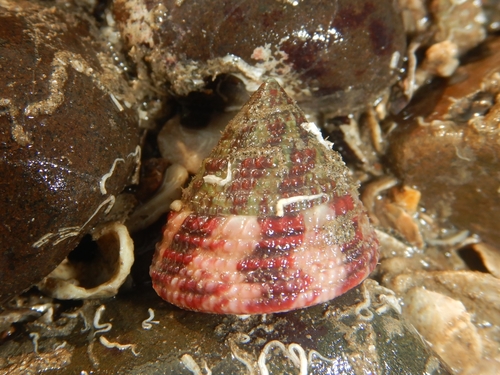
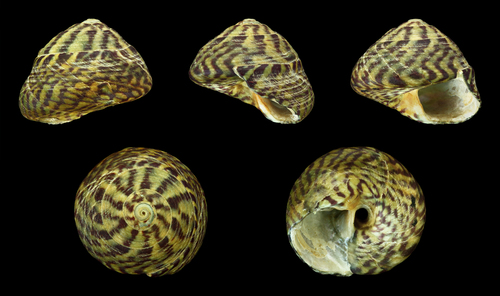
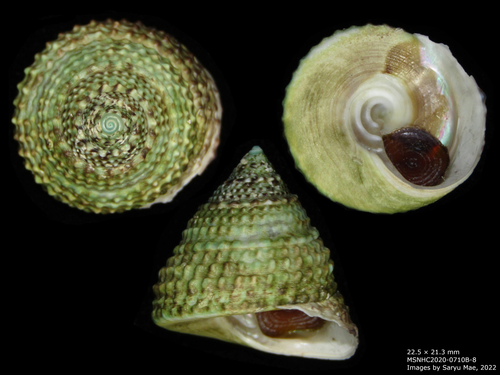
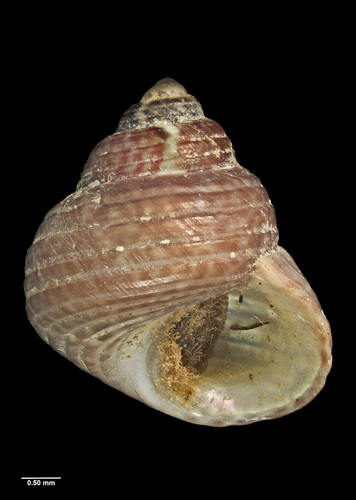
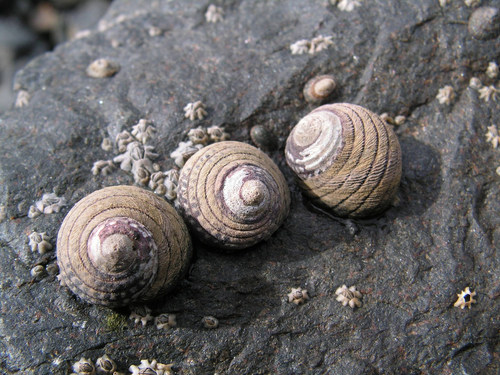
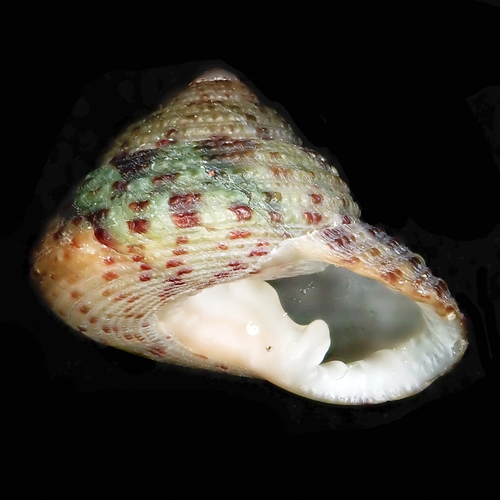
Clanculus clangulus (W.Wood, 1828) is a marine sea snail species in the genus Clanculus. The size of its shell typically ranges between 10 mm and 13 mm. The shell has a conical shape, and its spire is decidedly higher in general than that of Clanculus floridus. The shell is subcarinate, nearly rounded at the periphery, and very deeply umbilicated. Its base color is brownish, or more frequently a beautiful emerald green that is much paler on the lower portion of the shell. The upper surface of the shell has broad crimson radial maculations; these colored markings do not extend below the periphery, and both the periphery and the base of the shell are dotted with the same crimson shade. The spire usually tapers toward the acute, rose-colored apex. The shell has approximately 6 convex whorls, with the final whorl deflected anteriorly. The whorls have spiral sculpture made up of around 18 closely spaced granose cinguli, 5 to 8 of which are the principal cinguli located above the periphery. The interstices between these cinguli hold granose riblets and sharp oblique striae. In older individuals, differences in the size of the lirae on the upper surface are often barely noticeable. The base of the shell bears much finer, more closely spaced granulose lirae. The aperture is very oblique and has a subquadrangular shape. The outer lip is plicate on its inner surface. The tooth located near the superior angle of the aperture is only slightly developed. All other structural details of the aperture and umbilicus match those of Clanculus personatus, with the only difference being that the parietal area is scarcely wrinkled. This marine species is endemic to Australia, where it occurs off the coasts of New South Wales and Queensland.