About Clamator jacobinus (Boddaert, 1783)
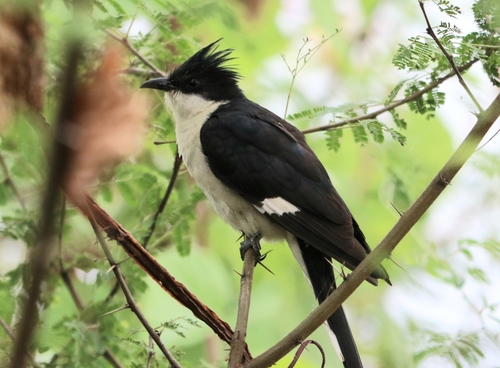
This is a medium-sized, slim black and white cuckoo with a crest, making it distinctive. Its white wing patch on the black wing and overall pattern mean it can be identified even in flight. Individuals are very vocal during the breeding season. Its call is a ringing series of whistling "piu-piu" notes; the calls of the nominate form are more rapid and slightly mellower. In India, the subspecies serratus (Sparrman, 1786) is a summer breeding visitor to northern India, and is believed to migrate to southern Africa. This subspecies is larger and longer-winged than the nominate subspecies, which is found in southern peninsular India and Sri Lanka and described as a local migrant. There is no ringing evidence to confirm that this subspecies actually migrates to Africa. In Africa, subspecies serratus and pica (Hemprich & Ehrenberg, 1833) have two distinct color phases: a pied phase where the underparts are white or whitish, and a black phase where the only white marking is the wing patch. Mating appears to be assortative, with pied phase males pairing with pied phase females. An all-rufous color phase has been recorded in Central Africa. There is no clear consensus on the species' migration patterns and plumage variation. It has been claimed that subspecies pica is the form that migrates between Africa and India, but Rasmussen & Anderton (2005) suggest serratus is the valid name for Afro-Indian migrants. In the past, other African subspecies have been proposed: hypopinarus from South Africa and caroli from Gabon. The species is distributed south of the Sahara in Africa, and south of the Himalayas in India. It is also found in Sri Lanka and parts of Myanmar. Within Africa, the species makes local movements, though it is resident in tropical Africa; the east African population is migratory and moves across southern Arabia into India during April. Its main habitat is thorny, dry scrub or open woodland, and it avoids dense forest or extremely dry environments. During the breeding season, these cuckoos call from prominent perches and chase each other with slow wing-beats and pigeon-like clapping flight. Courtship feeding has been observed in African populations. This species is a brood parasite. In India, its main hosts are babbler species in the genus Turdoides. The cuckoo's egg color matches that of its host, typically turquoise blue. The cuckoo's eggs are slightly larger than those of the common babbler (T. caudatus) or the jungle babbler (T. striata). Another recorded host is the red-vented bulbul, and cuckoo eggs laid in this host's nests are mostly white. Cuckoo females lay their eggs hurriedly in the morning into the host's nest, often dropping them from above while perching on the nest rim, and usually lay them on top of the host's eggs. This often results in one or more host eggs cracking. In Africa, males distract the host while the female lays her egg. Multiple cuckoo eggs may be laid in a single host nest, and two young cuckoos have been recorded successfully fledging from the same nest on multiple occasions. In Africa, recorded hosts include Pycnonotus barbatus, P. capensis, Turdoides fulvus, Turdoides rubiginosus, Lanius collaris, Andropadus importunus, Terpsiphone viridis, Dicrurus adsimilis and a small number of other species. Babblers in the genus Turdoides are communal breeders, so cuckoo chicks are raised by multiple members of the babbler group. One pied cuckoo chick was observed being fed by four jungle babblers. The skin of newly hatched young cuckoos darkens from pink to purplish brown within two days of hatching. The inside of the mouth is red with yellow gape flanges. Unlike some other cuckoo species, this cuckoo's nestlings do not evict the host's eggs from the nest, but they do take most of the parental attention and food, which sometimes results in host nestlings starving to death. These cuckoos feed on insects, including hairy caterpillars, which they collect from ground level or near the ground. They press caterpillars from end to end to remove their guts before swallowing them, and they will sometimes feed on fruits. Jacobin cuckoos are occasionally preyed on by the Eurasian sparrowhawk (Accipiter nisus); sparrowhawks have been recorded attacking this significantly larger cuckoo by forcing it to the ground with their talons, then tearing it apart with their hooked beak.