About Cladorhynchus leucocephalus (Vieillot, 1816)
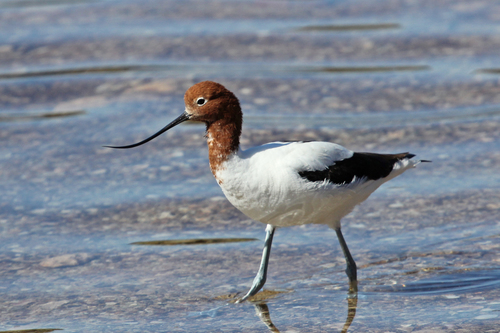
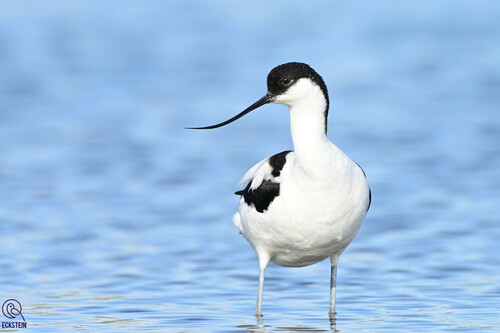
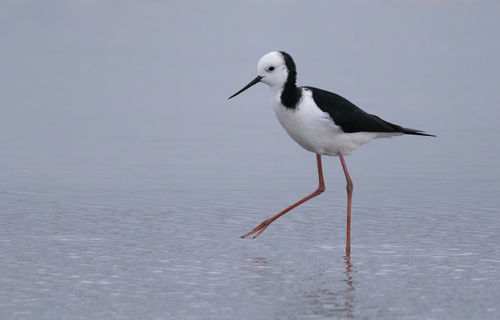
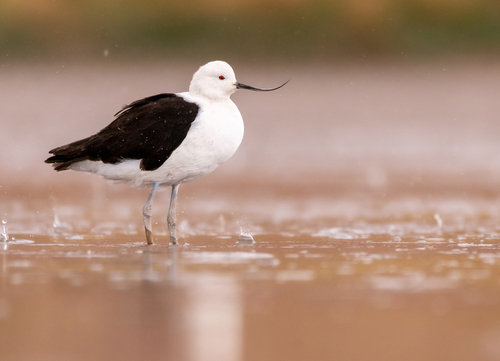
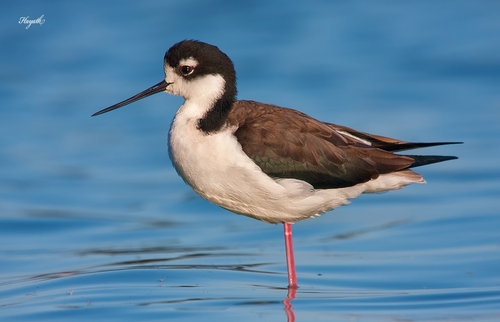
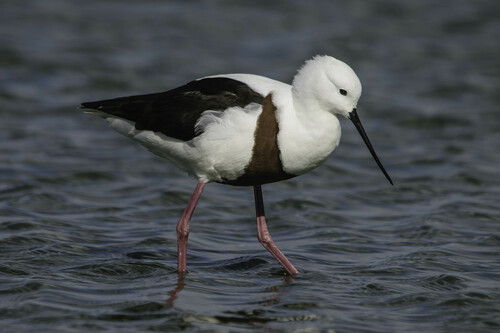
The scientific name of the banded stilt is Cladorhynchus leucocephalus (Vieillot, 1816). The banded stilt is 45–53 cm (18–21 in) long, weighs 220–260 g (7.8–9.2 oz), and has a wingspan of 55–68 cm (22–27 in). Adult breeding-plumage banded stilts are predominantly white with black wings and a broad, clearly demarcated U-shaped chestnut band across the breast. The central area at the base of the upper tail has a pale grey-brown tint. It has a slender, relatively straight black bill that is twice as long as its head. Its irises are dark brown, and its legs and feet are dark red-pink. The long, slim wings have 11 primary flight feathers, with the 10th being the longest. When in flight, the upper side of the wings is mostly black with a white trailing edge from the tips of the inner primaries, while the underside of the wings is mostly white with dark tips. White feathers on the head and neck have pale grey bases that are normally hidden. Non-breeding plumage is similar to breeding plumage, but the breast band is less distinct, often diluted to ashy brown or mottled with white, and the legs are paler orange-pink. There is no difference in plumage between males and females, and no geographic variation in plumage has been recorded. Juvenile banded stilts resemble adults but have a greyish forehead and lores, duller black wings, and do not have the characteristic breast band. They attain adult plumage in their second year. Juvenile legs and feet are grey, and become more blotched with pink until they reach adulthood. Nestling banded stilts are covered in white down. The banded stilt is a distinctive bird that is rarely confused with other similar species: the white-headed stilt has no breast band, and the red-necked avocet has a chestnut head and neck and a distinctly upcurved bill. Adult banded stilts produce a barking call written as cow or chowk, and sometimes it is two syllables as chowk-uk or chuk-uk. They also chatter softly and tunefully while nesting. The banded stilt is generally found in southern Australia. In Western Australia, it is mostly found in the southwestern corner, and can range as far north as the saltworks in Port Hedland. Breeding occurred at Lake Ballard in Goldfields-Esperance after heavy rainfall from Cyclone Bobby in 1995, and again after flooding in 2014. In 1933, a large colony was recorded at Lake Grace, but it was destroyed, presumably by a fox attack. The species has been recorded in southeastern South Australia, the Lake Eyre drainage system, Victoria west of Port Phillip, and the Wimmera. In July 2010, Lake Torrens filled with water, which brought around 150,000 banded stilts to the area. The Natimuk-Douglas Wetlands in western Victoria are an important nesting ground for the species, but fewer banded stilts nest here when flooding occurs elsewhere in southeastern Australia. In New South Wales, it is most commonly found in the Riverina and western parts of the state. It has also been spotted in southern Queensland and the Northern Territory, where it has been found at the sewage ponds in Alice Springs and Erldunda. It is recorded as a vagrant in Tasmania, with significant numbers recorded there in 1981. Its preferred habitats are large, shallow saline or hypersaline lakes located inland or near the coast, including ephemeral salt lakes, salt works, lagoons, salt or clay pans, and intertidal flats. It is occasionally found in brackish or fresh water, including farm dams and sewage ponds. The banded stilt is highly nomadic, adapted to the unpredictable climate of Australia's arid interior. Sudden rainfall fills dry inland salt lakes, and banded stilts travel to these areas to breed, then disperse and return to the coast once the lakes begin to dry up. It is unknown how coastal banded stilts detect inland rainfall. The species can travel very long distances: two birds were tracked traveling from a drying Lake Eyre in South Australia to a newly filled lake system in Western Australia over 1,500 km (930 mi) away. One of these birds traveled northwest across the Gibson Desert, covering a minimum of 2,263 km (1,406 mi) in 55.9 hours.