About Cladonia stygia (Fr.) Ruoss
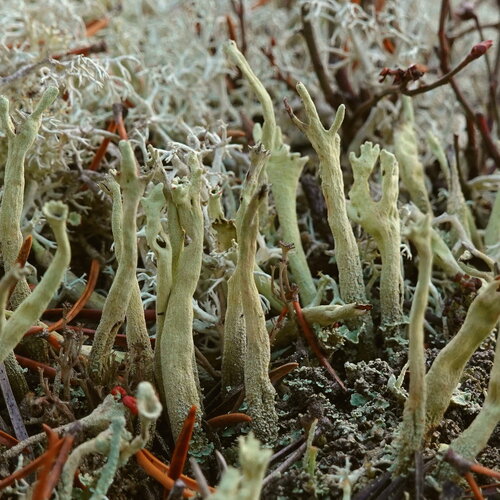
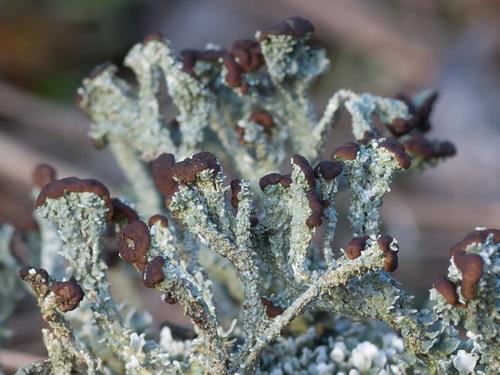
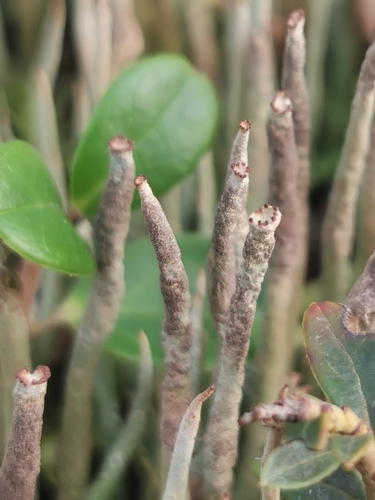
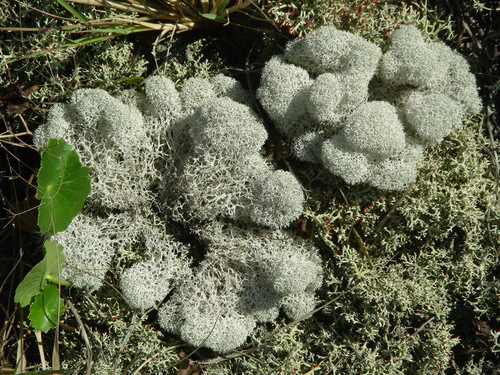
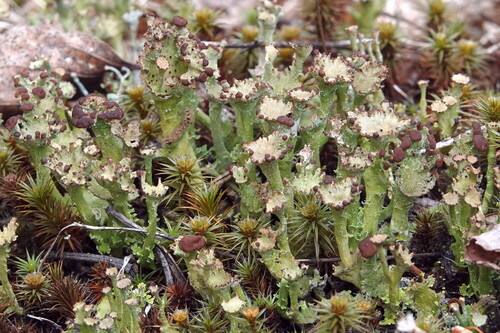
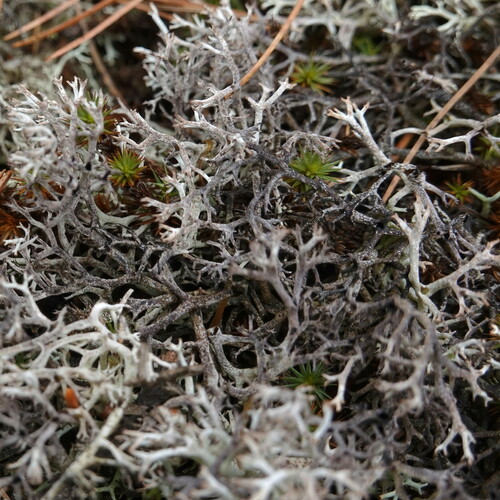
Like other members of the Cladonia genus, C. stygia has a two-part (dimorphic) structure: it starts life with a crust-like layer that grows on its substrate, but this layer eventually disappears as the more prominent upright, branching structures called podetia develop. The lichen is set apart by several characteristic structural features. Its podetia usually grow 5–15 cm tall, and can occasionally reach 30 cm, with the living, active portion measuring up to 10 cm. The main stem is roughly 1 mm thick, with segments between branches about 5 mm long. Its branching pattern is distinctive: it typically divides into three unequal branches (called anisotomic trichotomous branching), though it may sometimes split into four or two branches. At branch division points, it forms small holes or perforations called axils. The inside of the base of its branches has a distinctive ash-grey to black colour. This dark base is dotted with irregular patches of greenish-white outer tissue (the ectal layer), creating a characteristic speckled appearance. These patches often have uneven edges, and can sometimes look almost scale-like. While this mottled, darkened area usually covers the lower half of the branches, in some specimens it may only be found on the very base. When wet, the lichen can become olive-grey in colour. The podetia of C. stygia often have a distinct curve near their tips, giving them a characteristic hooked or walking cane-like shape. Unlike the relatively smooth podetia of C. rangiferina, C. stygia has a noticeably wartier surface texture, a feature that helps with field identification. Another difference is that C. stygia has darker olive-green upper podetia when moist, while C. rangiferina has more uniform greyish tones. The upper portions of the branches also have distinctive features. Terminal and near-terminal branches have a relatively rough surface with a felty but loosely fibrous covering, and they usually taper gradually to pointed tips. The branch tips are noticeably darkened and strongly bent to one side. The internal structure of the branches is made up of several layers: the branch wall is 225–275 micrometres (μm) thick, with a delicate cobweb-like surface layer (the arachnoid layer) that is 25–50 μm thick. One additional identifying trait is the red colour of its reproductive structures (pycnidia), though this characteristic is rarely visible and can be hard to observe in the field. The species reproduces via several structures. It commonly produces disc-shaped reproductive bodies called hymenial discs, which grow in clusters at the tips of branches. These discs are 0.5–0.8 mm wide, have a convex shape, and range from medium to dark brown in colour. The spores produced by these discs are simple, colourless (hyaline), and range from oblong to needle-shaped (fusiform to acicular), measuring 9–12 by 2.5–3 μm. The species also produces separate reproductive structures called conidiomata, which measure 150–200 by 100–110 μm and contain a distinctive red slime. These features help distinguish C. stygia from similar-looking C. rangiferina. While both species have some darkening at the base, C. rangiferina typically has a more uniform brownish colour instead of C. stygia's speckled black-grey pattern. C. rangiferina also differs in having smoother branch surfaces and shorter, blunter branch tips. Other similar species include C. arbuscula, C. mitis, and C. stellaris; these can be told apart from C. stygia by their yellow-green colouration and a negative K− spot test, which indicates they contain usnic acid and lack atranorin. Cladonia stygia is widespread across the Northern Hemisphere, but has a fragmented distribution in some regions. In Germany, even though the species was first recorded in Lower Saxony as early as 1908, it was not observed again until 2012, when new populations were found in the lichen-rich pine forests of the Carrenziener Dünen. Since that discovery, conservation efforts including experimental lichen reintroduction have successfully established additional populations within the dune system, where C. stygia grows alongside other reindeer lichens such as C. portentosa, C. arbuscula, and C. rangiferina. It has also been confirmed to occur in parts of Central Europe, including Germany (with recent reports from the federal state of Hesse) and the Czech Republic, as well as in Canada, Finland, and parts of Asia, supporting that it has a broad boreal or circumboreal distribution. In the Alps, it occurs from valley bottoms to the subalpine belt, mainly between 300 and 2400 m elevation, but it is relatively rare and restricted to raised bogs. It has been documented across multiple Alpine regions, including parts of Austria, Germany, Switzerland, France, Italy, and Slovenia. Although it is primarily a boreal species, C. stygia extends into both arctic and temperate zones, becoming increasingly restricted to specialised habitats at its southern limits; for example, it occurs in isolated mountain ranges such as the European Alps and the Blue Ridge Mountains in Virginia. It is widespread in Greenland and Svalbard. In the United Kingdom, C. stygia was recorded in the 19th century from the Scottish Highlands (Braemar) and Wales (Merioneth and Snowdonia). More recent records confirm its presence in Wales (Cardigan) and Scotland (East Perthshire and Caithness). Elsewhere in Europe, the species has been confirmed in Andorra, Italy, Portugal, Slovenia, and Turkey, where it typically grows on acid soils in montane and subalpine areas. Its southernmost European occurrence has been recorded in the western Sistema Central mountains of Portugal. The species is considered endangered in Italy, though data on its population status there remains incomplete. Cladonia stygia was definitively excluded from Southern Hemisphere fungal floras in 1990. Furthermore, although it is primarily found in peatlands, C. stygia also occurs on rock outcroppings in woods, particularly in southern Finland, and in Pinus sylvestris-Cladina woodlands further north, where it typically covers only 1–3% of the ground surface. In Germany, populations also occur in montane and high montane zones between 650 and 900 m elevation, favouring humid, cool sites such as basalt blockfields and high moors. Due to historical difficulty distinguishing C. stygia from similar species, especially C. rangiferina, its full distribution remains uncertain. Molecular studies have since confirmed its presence in regions where it was previously overlooked or misidentified. Because of its role in boreal ecosystems and its status as the only lichen taxon protected under EU legislation, populations of C. stygia are important for conservation monitoring, though challenges in field identification often require molecular verification for accurate population assessments. In boreal and subarctic regions, Cladonia stygia is ecologically significant. Like other reindeer lichens, Cladonia stygia often dominates groundcover and is a key winter food source for reindeer. The species has a strong preference for treeless, ombrotrophic bogs, where it may be more abundant than species such as C. rangiferina. It is tolerant of wet conditions, able to survive prolonged periods of inundation during spring and autumn, and in these consistently moist habitats, growth can reach up to 2 cm per year. In Austrian high moor and bog habitats, C. stygia typically occurs in relatively undisturbed areas dominated by Mountain Pine (Pinus mugo), where it grows alongside characteristic bog vegetation. Common vascular plant associates include the dwarf shrubs Calluna vulgaris (heather) and Andromeda polifolia (bog rosemary), the sedge Eriophorum vaginatum (tussock cottongrass), and Rhynchospora alba (white beak-sedge). Other lichens found in these communities include Cladonia pyxidata, C. coniocraea, and C. fimbriata, while typical bryophyte associates are Pleurozium schreberi, Aulacomnium palustre, Sphagnum rubellum, and Leucobryum glaucum. Although C. stygia is present in undisturbed bogs with this characteristic vegetation, studies have found it absent from peat-harvested bogs even when other typical bog species persist, which suggests it may act as an indicator of relatively undisturbed bog habitats. Research conducted in northwestern Alaska has shown that C. stygia grows at an average rate of 6.2–6.5 mm per year, with faster growth rates (7.0–7.8 mm/year) observed in more continental eastern sites compared to 5.2–5.5 mm/year in oceanic western sites. Individual thalli can live to at least 30 years of age, though older portions may decay over time, and growth rates do not appear to be strongly correlated with climate variables such as temperature or precipitation. A comparative study in Quebec found C. stygia in 20–53% of logged plots, while it was largely absent from burned sites; this suggests that the species recovers more effectively from logging disturbances than from fire. Studies in alpine environments have further revealed that C. stygia plays an important insulating role in regulating soil temperature. Its distinctive morphology, made up of hollow, round podetia that form thick, bush-like mats with high water-holding capacity, provides stronger soil insulation than both bare ground and other lichen species. Although its darker colouration might suggest a role in solar absorption, research indicates that water retention is the primary driver of its insulating properties, which effectively reduces soil temperature fluctuations and mitigates freeze–thaw cycles.