About Cladonia stellaris (Opiz) Pouzar & Vĕzda
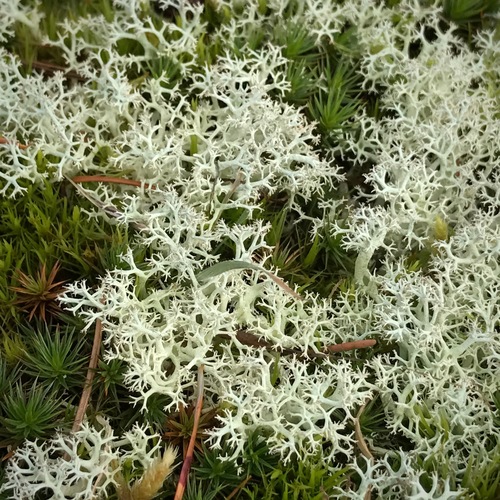
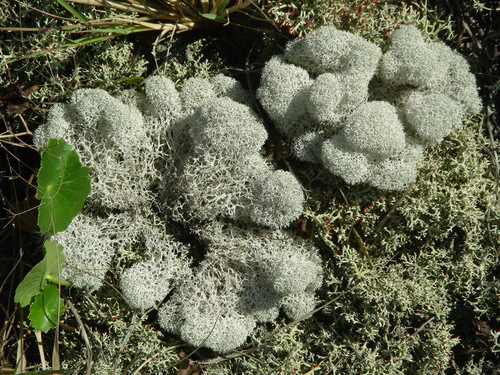
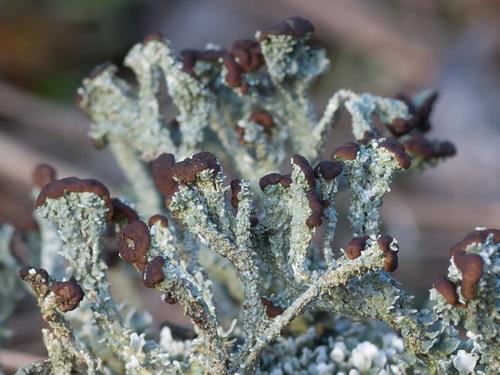
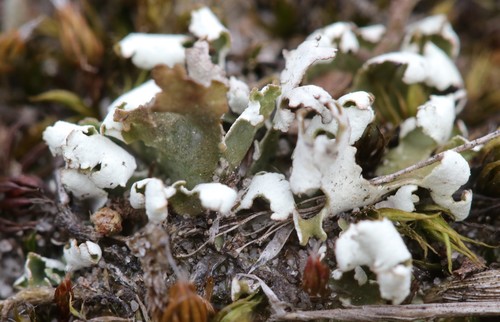
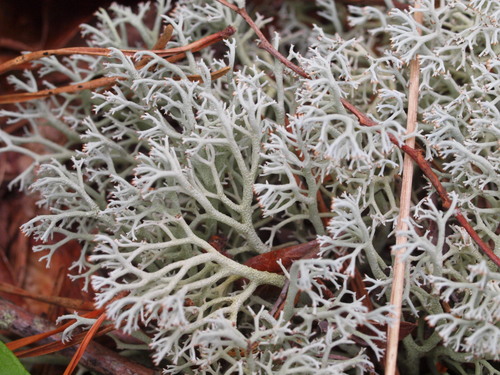
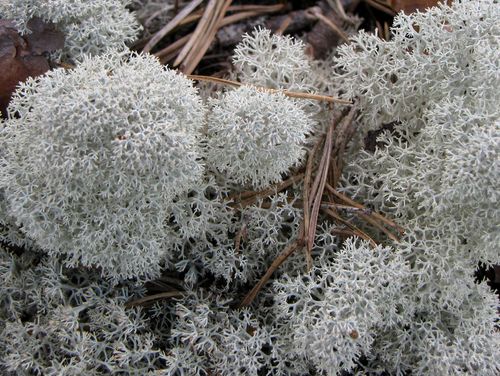
Cladonia stellaris, commonly called star-tipped cup lichen or star reindeer lichen, is an ecologically important species of cup lichen. It grows in continuous mats across large ground areas in boreal and arctic regions of the circumpolar north. It is a preferred winter food source for reindeer and caribou, and it plays a key role in regulating nutrient cycling and soil microbiological communities. Like many other lichens, humans use Cladonia stellaris directly for its chemical properties: many of its secondary metabolites, such as usnic acid, are antimicrobial. It is uniquely harvested and sold as "fake trees" for model train displays, and is also used as a sound absorber in interior design. The fungal component of this lichen, called the mycobiont, protects the organism from lichen-eating animals, excess solar radiation, and other stressors found in its native ecosystem. Cladonia stellaris is mat-forming and fruticose, meaning it has a shrub-like appearance. It is a terrestrial, terricolous, epigeic species, meaning it grows on the surface of bare soil or gravel. Like most lichens, it grows slowly, averaging less than 0.5 cm of growth per year even under favorable conditions. It can be distinguished from similar species Cladonia rangiferina and Cladonia arbuscula by its much more distinct cushion-shaped patches, and denser branching when viewed from above. Following an online vote sponsored by the Canadian Museum of Nature, the star-tipped cup lichen was unofficially named Canada’s national lichen.