About Cladonia grayi G.Merr. ex Sandst.
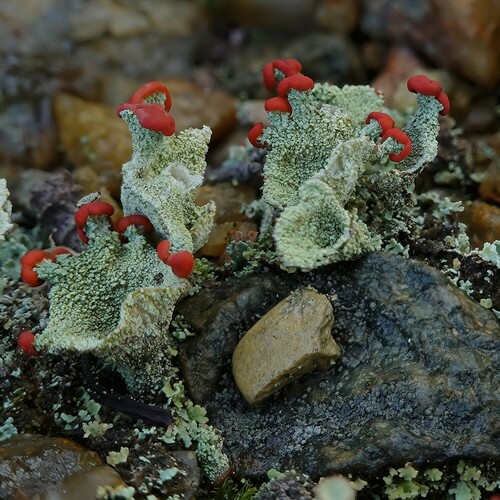
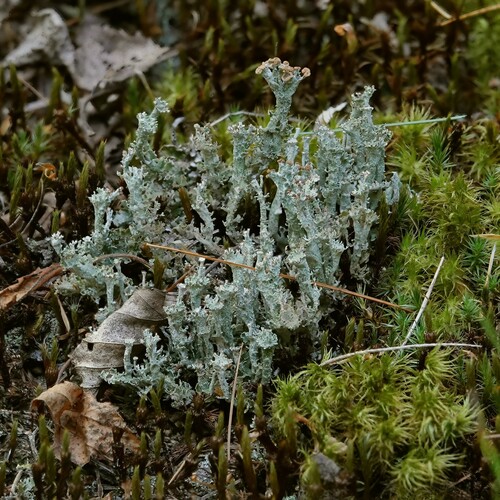
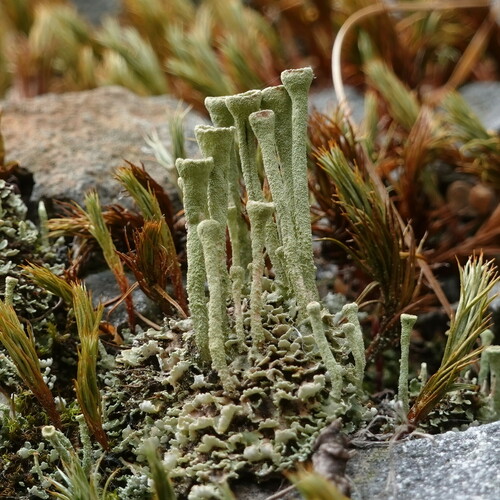
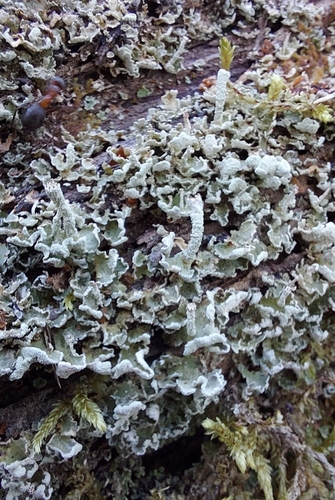
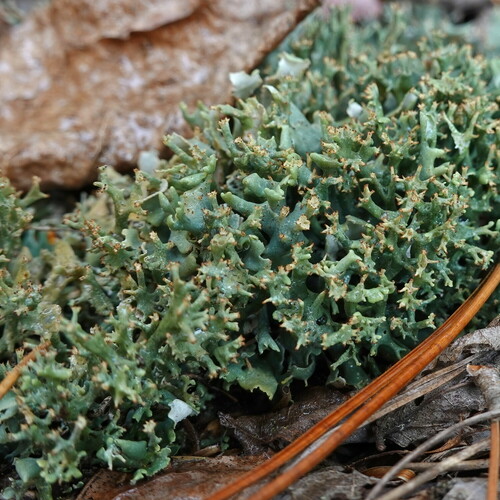
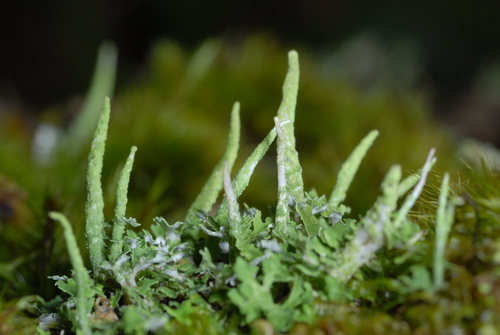
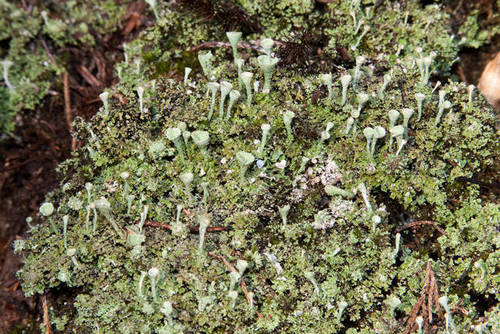
Cladonia grayi G.Merr. ex Sandst. has two main structural parts: a primary thallus made up of small, persistent leaf-like structures called squamules, and a secondary thallus made up of upright stalks called podetia. The squamules form a crusty layer on the growing substrate; they are 1 mm long and 1–2 mm wide, with wavy edges, and tend to grow upward. The podetia are the species' most distinctive feature, growing 5–15 mm tall and 2–7 mm wide. They are goblet-shaped (scyphose), with long, narrow stalks that expand into round, globe-like cups at the top. These structures are typically light greyish-green, but can appear dark or somewhat brownish. The surface of the podetia is covered with a protective cortex that may be bumpy, and may peel off in patches as the lichen ages. Upper portions of podetia develop powdery areas called soralia, plus granules 40–130 micrometres in diameter, or may produce small flaking squamules. The granules are thought to play a role in propagating the species. The species' reproductive structures include dark brown spore-producing discs called apothecia, which occur uncommonly along cup margins, and more frequent smaller structures called pycnidia, which produce a clear fluid. Cladonia grayi is a widespread, highly adaptable lichen species that can grow on multiple substrates, including rotting wood, humus (organic soil layers), and bare ground, with a strong preference for highly acidic conditions. While it has an almost cosmopolitan distribution, it is most abundant in the Northern Hemisphere, particularly in Arctic and temperate regions. In Mediterranean areas, it is relatively uncommon, occurring in scattered populations primarily in meso- to supramediterranean zones, and prefers Eurosiberian regions from colline to montane elevations. It is also present in the Southern Hemisphere, with documented occurrences in both Neotropical regions and Australasia, though these populations are more dispersed and typically found at higher altitudes. Cladonia grayi appears to be the most common member of the C. chlorophaea group in Belarus, where it makes up approximately 40% of specimens examined in one comprehensive survey. Two chemotypes have been recorded in Belarus at roughly equal frequency: one contains only grayanic acid and 4-O-demethylgrayanic acid, and the other additionally contains substances of the fumarprotocetraric acid complex. In Belarus, the species has distinct ecological preferences: around 90% of recorded occurrences are in pine forests across a range of humidity conditions, from wet boggy areas to extremely dry stands. It has been documented growing on various substrates including pine bark, soil, decaying wood, juniper, oak, birch, hornbeam and alder bark; chemotype I tends to occur more frequently on acidic tree bark, while chemotype II is more commonly found on soil and wood.