About Cladonia cariosa (Lilj.) Spreng.
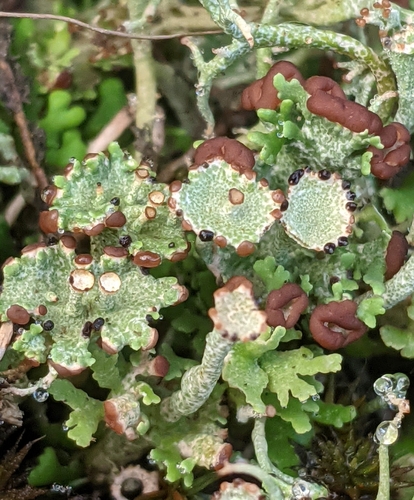
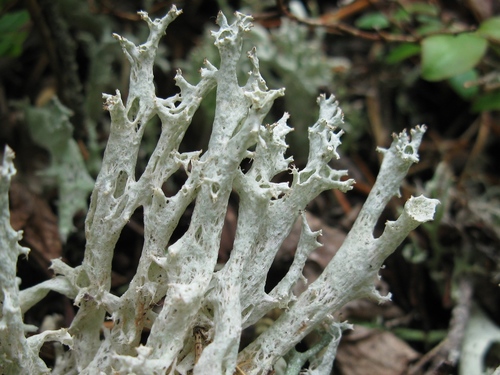
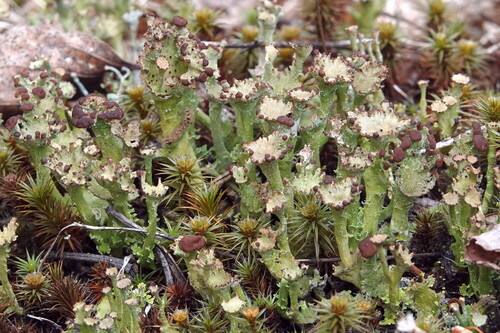
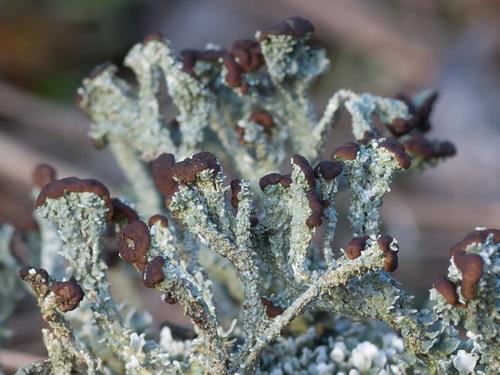
The primary thallus of Cladonia cariosa typically forms a low mat 2–6(9) mm deep, composed of small to medium squamules that measure 1–3(6) mm by (0.5)1–1.5 mm. Its upper surface is pale green to olive or tan, ranges from smooth to slightly roughened, and is sometimes lightly pruinose near the edges. The podetia are mostly 1–3 cm tall, simple to branched, often with fissured and split sides, and usually bear terminal, convex to almost spherical, brown to dark-brown apothecia. All strictly defined western North American specimens identified as C. cariosa contain atranorin. Five chemotypes have been detected: the most frequent is atranorin alone, and the others are atranorin paired with either fumarprotocetraric acid, homosekikaic acid, norstictic acid, or porphyrilic acid. Rangiformic acid has been reported as an extra compound in some chemotypes, but the authors note that newly sequenced specimens in their study were not screened for fatty acids like rangiformic acid due to the type of TLC plates they used. Cladonia peziziformis looks somewhat similar to C. cariosa, but can be told apart by differences in chemistry, its paler brown apothecia, and its greener podetia. Squamulose Cladonia colonies that lack podetia are often hard to identify, since many diagnostic characteristics are found on the podetia; when podetia are absent, chemical tests may be inconclusive and DNA sequencing may be required. Mixed or poorly developed specimens are common within the C. cariosa group; a 2024 study recommends spot-testing individual squamules from different parts of a collection, especially when the squamules vary in appearance. For specimens without DNA data, the study suggests limiting the classification of Cladonia galindezii to material with large squamules that form a deep cushion and contain porphyrilic acid, while noting that young or stressed colonies may not be distinguishable from C. cariosa without sequencing. Cladonia cariosa is a widespread lichen with a cosmopolitan distribution. It grows directly on soil, occurring in both calcium-rich and calcium-poor sites, as well as in sun-exposed sandy soil. It is widely distributed in northern North America. In western North America, it has been collected growing on soil in a variety of settings, including both open and partially shaded roadcuts, shale-derived soils, and sagebrush grassland soils. Lichenozyma pisutiana, a yeast in the class Cystobasidiomycetes, has been found to associate with Cladonia cariosa.