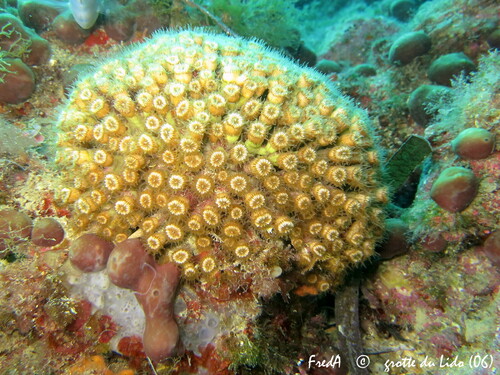
About Cladocora caespitosa (Linnaeus, 1767)
This species has the scientific name Cladocora caespitosa (Linnaeus, 1767). Its individual polyps are clear maroon in colour, measure around 5 mm in diameter, and form cushion-shaped colonies. C. caespitosa lives in symbiosis with Zooxanthella algae. The polyps produce calcium carbonate deposits that form the calcareous structures they inhabit. It is the largest stony coral found in the Mediterranean, and can reach up to 50 cm in colony diameter. The average generation length of this species is approximately 30 years. This species is endemic to the Mediterranean Sea, and fossil evidence confirms its presence in the region as early as the Upper Pliocene. It is commonly found on rocky seabeds at depths ranging from a few metres down to 60 metres. A small reef made entirely of C. caespitosa is located in Veliko Jezero marine lagoon, within the Mljet island marine reserve in Croatia; this reef was long thought to be the only true coral reef in the Mediterranean. Recent discoveries in the Adriatic Sea have shown that C. caespitosa is not the only reef-building coral species in the Mediterranean. An extensive corallith bed formed by C. caespitosa has also been found in the Tremiti Islands Marine Protected Area. C. caespitosa colonies grow through budding, and the species spreads when plankton-like larvae settle on suitable seabed for colonisation.

