About Cittarium pica (Linnaeus, 1758)
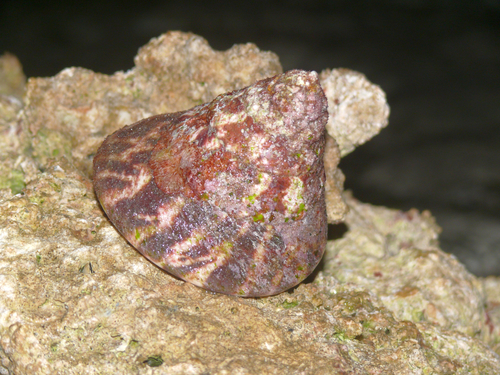
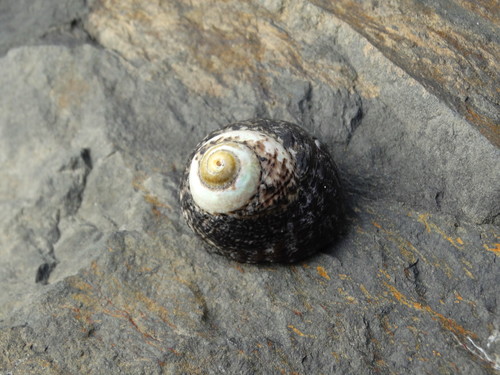
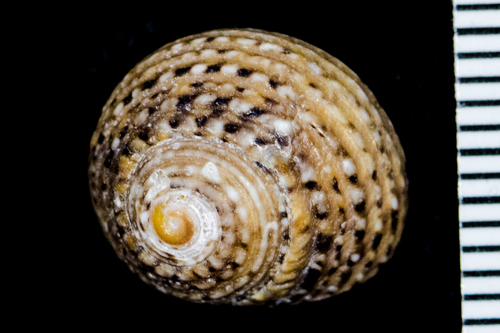
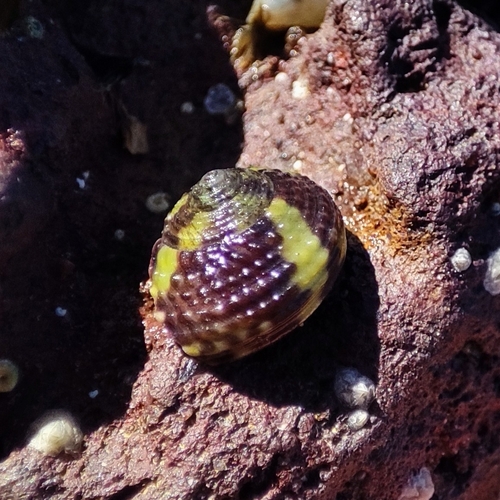
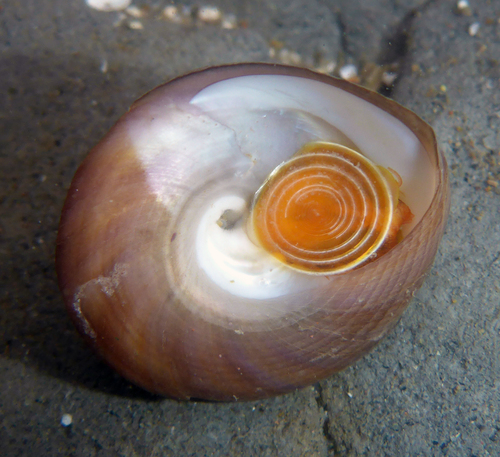
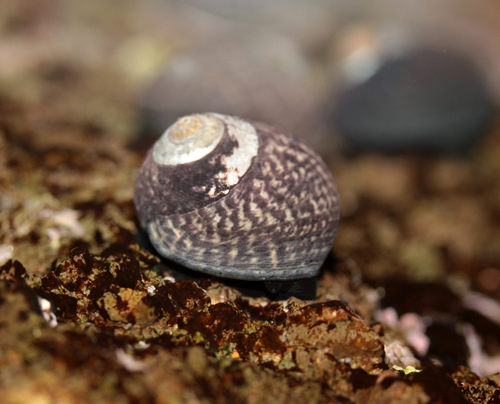
Cittarium pica is a species of large sea snail first described by Linnaeus in 1758. The maximum dimension of an adult Cittarium pica shell reaches up to 137 mm. The shell is very thick and heavy, with a shape between trochiform and turbiniform, rounded shoulders, and a somewhat low conical form. The spire is conoidal, and the shell holds approximately six convex whorls. The large body whorl is depressed-globose. The outer lip is simple, and is edged on the inside with black, or a mix of black and white. The arcuate columella has a heavy porcellanous callous deposit above it, half-surrounds the umbilicus, and is deeply notched in the middle. The shell has a rather wide, deep umbilicus that is free of external sculpture, but is spirally bicostate on the inside. The semicircular, oblique aperture is circular and distinctly nacreous inside, as is typical for other members of the superfamily Trochoidea. The glossy, delicate parietal callus has a node that projects toward the umbilicus. Juvenile shells are ornamented with spiral lines and strong cords, while mature shells have a nearly smooth, uniform surface. The shell has a lusterless, distinct color pattern: it is overall white, marked with black zigzag flammules on each whorl. In older, larger individuals, these black spots tend to become axial lines. The upper surface of the shell is often entirely black. The aperture is most commonly white, with inner iridescence from its nacre. Young shells, or well-preserved adult shells, have spire whorls sculptured with oblique folds, cut by a small number of spiral sulci. In half-grown individuals, the periphery and base of the shell are spirally lirate. On some old empty shells from large individuals, the black colored portions are slightly higher in relief than the surrounding white areas. This unusual feature is thought to be caused by blue-green algae such as Plectonema terebrans, which continuously erode the white areas of the shell surface. This species is rarely found in the Florida Keys, and also occurs along the Caribbean coasts of Mexico, Costa Rica, Panama, Colombia, and Venezuela. It is also found in the Bahamas, Cuba, the Cayman Islands, Jamaica, Haiti, the Dominican Republic, Puerto Rico, and the Lesser Antilles, ranging as far south as Barbados and Trinidad and Tobago. It has been reintroduced to Bermuda, after becoming locally extinct there. This large snail lives on or under rocks on exposed and moderately sheltered shores, in both intertidal and shallow subtidal zones. Cittarium pica generally does not occur at great depths, though occasional deep records exist. Most individuals are found at the water's edge, and have little tendency to disperse. The minimum recorded depth for this species is 0 m, and the maximum recorded depth is 7 m. Cittarium pica is dioecious, meaning every individual is distinctly either male or female. This species has external fertilization. Its reproductive season in the wild typically runs from June to November: during this time, males release sperm into the water while females simultaneously release their unfertilized green eggs. When gametes meet, they produce yolky fertilized eggs that develop into lecitotrophic (yolk-feeding) larvae. Larvae hatch from egg capsules as shell-cap-bearing trochophores. These trochophore larvae spend only a short time in the plankton, and settle relatively soon, between 3.5 and 4.5 days after hatching. Individuals usually reach sexual maturity when their shell reaches 32–36 mm in length. The life span of Cittarium pica is still unknown, though estimates for related top shell species reach up to 30 years. These large sea snails are boiled and eaten in many different local recipes. Due to their popularity as food and overfishing, the US Virgin Islands has put protective territorial regulations in place: collecting is prohibited during the reproductive season, and there is a minimum harvest size. Because of overharvesting, Cittarium pica became locally extinct in Bermuda. This local extinction had a serious impact on land hermit crab populations, as the crabs rely on empty Cittarium pica shells (or other similarly large shells) to use as shelter. Cittarium pica is now a legally protected species in Bermuda, where collection of the snails is forbidden.